The future of manufacturing is no longer simply about buying a faster CNC machine.
It is about building a production system where the machine, robot, software, sensors, tooling and data work together.
That was one of the clearest messages from EMO Hannover 2025, where automation, artificial intelligence, digitalization and sustainability dominated discussions around the future of production technology.
Held in Hannover from September 22–26, 2025, EMO brought together around 1,600 exhibitors from 45 countries and approximately 80,000 trade visitors. The event demonstrated how quickly machine tools are evolving from standalone equipment into connected and increasingly autonomous production systems.
For CNC manufacturers, job shops, automotive suppliers, aerospace companies and industrial automation providers, the message is important:
The next competitive advantage will not come from the CNC machine alone. It will come from how intelligently the entire manufacturing process is connected and automated.
So, what were the most important automation trends emerging from EMO Hannover?
Let’s take a closer look.
1. CNC Machines Are Becoming Automation Platforms
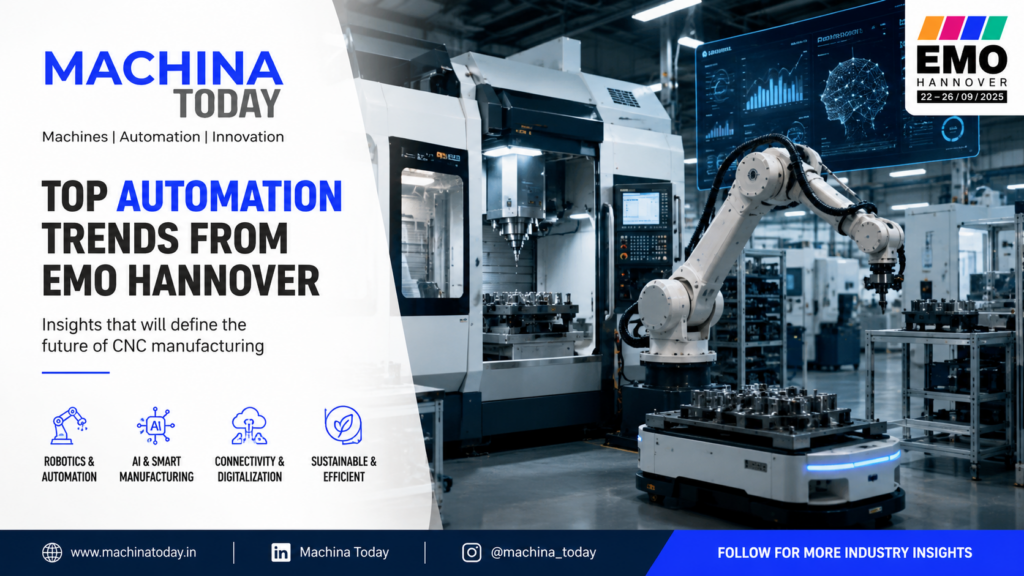
One of the biggest shifts visible at EMO Hannover was the movement from the standalone CNC machine toward the automated machining cell.
Traditionally, a CNC machine required an operator to:
- Load the component
- Start the machining cycle
- Monitor the process
- Remove the finished component
- Measure the part
- Handle chips and coolant
- Prepare the next job
Modern production systems are increasingly combining these tasks into one integrated workflow.
Automation can now include:
CNC machine + robot + pallet system + tool management + measurement + inspection + software + production data
This creates a much more productive manufacturing cell.
EMO itself highlighted automation solutions ranging from relatively simple handling and pallet-changing systems to highly automated production environments and autonomous transport systems.
Why this matters
For manufacturers in the USA, Germany, France and other advanced manufacturing markets, automation is becoming less about replacing workers and more about increasing machine utilization while allowing skilled employees to focus on higher-value tasks.
2. Robot-Tended CNC Machining Is Becoming Mainstream
Industrial robots were one of the most visible parts of the automation story at EMO.
Robot-tended machining allows a robot to automatically:
- Pick up raw material
- Load the CNC machine
- Start the machining cycle
- Remove the finished component
- Transfer it to inspection or another process
- Load the next component
This is particularly valuable for repetitive production.
But the more interesting development is flexibility.
Modern robotic systems are increasingly designed to work with different parts, machines and production requirements instead of being locked into one highly specialized process.
EMO’s organizers identified robotics as an increasingly important part of machine-tool automation, with robot manufacturers demonstrating solutions designed to work alongside human operators.
The bigger opportunity
For CNC machine manufacturers, the question is increasingly changing from:
“Can we automate this machine?”
to:
“How easily can this machine become part of an automated factory?”
That difference could become a major competitive factor.
3. Autonomous Mobile Robots Are Connecting the Factory
Robot automation is no longer limited to a fixed robot beside a CNC machine.
A major development is the growth of AMRs — Autonomous Mobile Robots.
Instead of keeping material in one location, AMRs can move:
- Raw materials
- Finished components
- Tools
- Pallets
- Fixtures
- Containers
between different areas of a factory.
One notable example presented at EMO 2025 was the DMG MORI AMR 1000, designed for autonomous transport of workpieces and tools.
DMG MORI also demonstrated the scale of its automation strategy: 33 of more than 40 machines displayed at its EMO presentation were automated.
This is an important signal for the CNC industry.
The future factory may not consist of individual automated machines.
Instead, it may operate as a network of automated machines connected by autonomous material movement.
4. AI Is Moving From the Hype Stage Toward Practical CNC Applications
Artificial intelligence was another major theme at EMO Hannover.
But the most interesting applications were not necessarily futuristic humanoid robots.
They were practical factory-floor applications.
AI can potentially help manufacturers with:
- Predictive maintenance
- Process optimization
- Machine diagnostics
- Production planning
- Tool-life prediction
- Quality monitoring
- Data analysis
- Operator assistance
- Energy optimization
EMO’s technical closing report highlighted AI applications including digital assistants, AI-supported process optimization and systems that analyze production data to identify patterns and deviations.
This is particularly important for CNC machining because modern machines generate enormous amounts of data.
The challenge is no longer simply collecting data.
The challenge is turning that data into useful decisions.
5. AI Assistants Could Change How Operators Use CNC Machines
One of the more interesting developments demonstrated at EMO was the use of AI-powered assistants for machine operation.
Imagine an operator asking:
“Why has this machine stopped?”
Instead of searching through hundreds of pages of documentation, an AI assistant could potentially analyze machine status, alarms and available technical information and provide a contextual explanation.
Siemens demonstrated developments around AI-supported CNC control interaction, including assistance with programming, process variables, diagnostics and maintenance. Heller also demonstrated its ASK.me digital assistant for maintenance, fault diagnosis and machine status.
This could have an enormous impact on factories facing skilled-worker shortages.
The future CNC operator may become more digital
The operator of tomorrow may not need to memorize every machine parameter.
Instead, the operator may increasingly work with:
CNC + AI assistant + automation + real-time data
Human experience will remain critical, but AI can help make that experience more accessible.
6. Predictive Maintenance Is Becoming More Intelligent
Unplanned machine downtime is expensive.
A machine that stops unexpectedly can affect:
- Production schedules
- Delivery commitments
- Machine utilization
- Labour efficiency
- Customer relationships
Traditional maintenance often follows a fixed schedule.
Predictive maintenance takes a different approach.
Sensors and software can monitor machine conditions and identify unusual patterns before a serious failure occurs.
AI can further analyze this information to detect deviations and support maintenance decisions.
EMO showcased applications where machine and production data can be analyzed to support predictive maintenance and process optimization.
For CNC manufacturers, this creates another competitive opportunity:
The machine sale could become the beginning of a digital service relationship rather than the end of the transaction.
7. Digital Twins Are Connecting the Physical and Digital Factory
Another major automation trend is the growing use of digital twins.
A digital twin creates a digital representation of a physical machine, process or production environment.
In CNC manufacturing, this can help companies simulate and optimize processes before making physical changes.
Potential applications include:
- CNC process simulation
- Production planning
- Tool-path optimization
- Factory layout
- Machine utilization
- Maintenance planning
- Energy analysis
- Virtual commissioning
EMO identified digital twins, connected machines, IoT, cloud computing and intelligent data analysis as important components of the industry’s digital transformation.
The long-term goal is simple:
Make more decisions digitally before spending time and resources physically.
8. Open Interfaces Are Becoming Critical for Smart Factories
A smart factory cannot operate effectively if every machine speaks a completely different digital language.
This is why open and standardized communication interfaces are becoming increasingly important.
EMO highlighted umati, based on OPC UA, as an important initiative for machine-tool connectivity. The event also demonstrated umati’s communication with MTConnect and connections involving digital production information.
This matters because a modern factory may contain machines from:
- Japanese manufacturers
- German manufacturers
- American manufacturers
- Korean manufacturers
- Italian manufacturers
- Indian manufacturers
A successful Industry 4.0 environment needs these systems to communicate.
The future machine-tool buyer will increasingly ask:
“How well does this machine integrate with my existing digital ecosystem?”
—not simply:
“What is the spindle speed?”
9. Lights-Out Manufacturing Is Becoming More Realistic
One of the biggest goals of CNC automation is lights-out manufacturing.
The idea is straightforward:
Machines continue producing components with minimal human intervention, including during evenings or overnight periods.
However, true lights-out production requires much more than a robot.
It requires:
- Reliable CNC machines
- Automated material loading
- Tool-life monitoring
- Process monitoring
- Automatic inspection
- Chip management
- Coolant management
- Production scheduling
- Error detection
- Remote monitoring
- Reliable communication systems
This is why the trend toward autonomous production is so important.
The factory is evolving from isolated automated machines into integrated production ecosystems.
10. Process Integration Is Reducing the Number of Setups
Another important trend visible at EMO was the increasing integration of multiple machining processes.
Instead of moving a component between multiple machines, manufacturers are increasingly looking toward machines capable of combining processes.
For example:
Milling + turning + grinding
or
5-axis machining + inspection + automation
The benefit is not simply saving floor space.
Fewer setups can mean:
- Reduced handling
- Lower setup time
- Improved consistency
- Better accuracy
- Shorter lead times
- Reduced work-in-progress
DMG MORI’s DMC 125 FDS DuoBlock, for example, demonstrated the integration of milling, turning and grinding in one setup.
This points toward an important manufacturing principle:
The fewer times a component has to be touched, transferred and repositioned, the more efficient the production process can become.
11. Automation Is Expanding Beyond Loading and Unloading
Automation used to mean:
Load → Machine → Unload
That definition is becoming outdated.
Modern automation can also include:
- Cleaning
- Deburring
- Measuring
- Inspection
- Labeling
- Tool management
- Pallet management
- Material transportation
- Data collection
EMO’s automation program specifically highlighted the growing integration of ancillary processes such as cleaning, labeling and measuring.
This creates an opportunity for machine-tool manufacturers to sell complete production solutions instead of individual machines.
12. Sustainability Is Becoming Part of Automation
Automation and sustainability may sound like separate topics.
They are increasingly connected.
A more intelligent production system can potentially reduce:
- Energy consumption
- Material waste
- Scrap
- Unnecessary machine running
- Coolant consumption
- Unplanned downtime
EMO highlighted energy and resource efficiency as part of its sustainability focus.
One example discussed by the organizers showed how optimizing coolant flow could significantly reduce energy consumption associated with pumping and production systems.
This matters particularly in Europe, where energy costs, environmental targets and sustainability requirements are increasingly influencing manufacturing investment decisions.
What Do These EMO Automation Trends Mean for CNC Manufacturers?
The most important takeaway is that the CNC machine industry is changing from a hardware-first market toward a systems-and-software market.
A competitive CNC manufacturer increasingly needs to think about five layers:
1. Machine
Accuracy, rigidity, spindle performance, speed and reliability.
2. Automation
Robots, pallet systems, loading systems and material handling.
3. Intelligence
Sensors, AI, monitoring and predictive maintenance.
4. Connectivity
OPC UA, umati, MTConnect and factory-level communication.
5. Optimization
Production planning, digital twins, process optimization and energy efficiency.
The companies that successfully combine these layers can offer something much more valuable than a standalone machine.
They can offer a production solution.
Why This Matters for the USA, Germany and France
The automation trend is global, but the priorities vary by market.
USA
American manufacturers are strongly focused on productivity, labour availability, reshoring and flexible automation.
For many manufacturers, the business case is straightforward:
Increase machine utilization + reduce manual handling + improve production consistency.
Germany
Germany remains one of the world’s most important machine-tool and industrial automation markets.
The challenge is particularly important for SMEs facing cost pressure and skilled-worker shortages.
EMO itself highlighted automation as a major response to these pressures.
France
French manufacturers are also increasingly focused on automation, industrial competitiveness, advanced machining and digital production.
For aerospace, automotive and precision engineering, combining CNC machining with robotics, inspection and digital monitoring can become increasingly important.
Global Manufacturing
From Japan and South Korea to India, the USA and Europe, the direction is increasingly similar:
More automation. More connectivity. More intelligence. Less dependence on manual repetitive processes.
What Should CNC Manufacturers Do Next?
The EMO Hannover message is not that every factory needs a fully autonomous factory tomorrow.
That would be unrealistic.
Instead, manufacturers should build automation progressively.
Step 1: Identify the bottleneck
Find the operation consuming the most labour, time or machine capacity.
Step 2: Automate the repetitive task
Start with pallet loading, part handling, inspection or tool management.
Step 3: Connect the machine
Collect useful production data.
Step 4: Add monitoring
Track machine utilization, tool condition, quality and downtime.
Step 5: Introduce AI where it creates measurable value
Use AI for specific problems rather than implementing AI simply because it is fashionable.
Step 6: Connect the factory
Move from individual automated cells toward a connected production environment.
This gradual approach can make automation more accessible to SMEs.
The Biggest Automation Trend: Integration
If there is one lesson CNC manufacturers should take from EMO Hannover, it is this:
Automation is no longer a separate technology.
It is becoming part of the machine.
Robotics, AI, CNC controls, sensors, software, inspection, material handling and production planning are increasingly being designed to work together.
That means the next generation of machine tools will likely compete not only on:
Accuracy + Speed + Rigidity
but also on:
Connectivity + Automation + Intelligence + Flexibility
The machine tool is becoming the center of a digital production ecosystem.
Final Takeaway
EMO Hannover 2025 showed that the future of CNC manufacturing is moving toward connected, automated and increasingly intelligent production.
Robots are becoming more capable.
AMRs are connecting production areas.
AI is moving into machine operation and diagnostics.
Digital twins are improving planning and simulation.
Open interfaces are making machines easier to connect.
Predictive maintenance is reducing the risk of unexpected downtime.
And process integration is helping manufacturers produce more with fewer setups.
But perhaps the most important lesson is that automation does not have to mean building a completely autonomous factory overnight.
The winners will be the manufacturers that know where automation creates real economic value and implement it step by step.
For CNC machine builders, automation companies and manufacturers in the USA, Germany, France, India and across the global manufacturing ecosystem, the direction is becoming increasingly clear:
The future factory will not simply be automated. It will be connected, intelligent and increasingly autonomous.
And EMO Hannover gave the industry a strong preview of what that future could look like.
Frequently Asked Questions
What are the biggest automation trends from EMO Hannover?
The major trends include CNC automation, industrial robotics, autonomous mobile robots, AI, predictive maintenance, digital twins, machine connectivity, process integration, automated inspection and increasingly autonomous production.
How is AI being used in CNC machining?
AI is increasingly being explored for predictive maintenance, process optimization, machine diagnostics, production planning, data analysis and operator assistance.
What is CNC automation?
CNC automation combines machine tools with technologies such as robots, pallet changers, automatic loading systems, inspection equipment and software to reduce manual intervention and improve production efficiency.
What is lights-out manufacturing?
Lights-out manufacturing refers to production that can continue with minimal human intervention, often outside normal working hours, using automation, monitoring and reliable production systems.
Why are robots important for CNC machining?
Robots can automate repetitive loading, unloading, handling and secondary operations, helping manufacturers increase machine utilization and maintain consistent production.
What is a digital twin in manufacturing?
A digital twin is a digital representation of a physical machine, process or production system that can be used for simulation, monitoring, optimization and planning.
Why are open interfaces important for CNC machines?
Open interfaces allow machines, robots, software and factory systems from different suppliers to exchange data more easily, making connected manufacturing environments more practical.
Is automation replacing CNC operators?
Not necessarily. Modern automation can reduce repetitive manual work while allowing operators and engineers to focus on programming, process improvement, quality, maintenance and higher-value activities.
What is the future of CNC manufacturing?
The industry is moving toward connected CNC machines, robotics, AI-assisted operation, predictive maintenance, digital twins, automated inspection and increasingly autonomous production systems.
Machina Today Perspective
At Machina Today, we believe the most important manufacturing story is not simply which company launched the newest CNC machine.
It is how machines, automation, robotics, AI and digital technologies are coming together to reshape the factory.
From CNC machining and machine tools to robotics, Industry 4.0 and smart manufacturing, the next decade will be defined by companies that can connect technology with real production value.
Follow Machina Today for more coverage of CNC machines, machine tools, automation, robotics, AI in manufacturing and global manufacturing technology.
The future of manufacturing is being built now.

IMTS 2026 Opens in Chicago: AI, CNC, Robotics and Automation Take Center Stage
IMTS 2026 is officially underway in Chicago, bringing the global manufacturing technology industry together at…
Top Aerospace Manufacturing Technologies in 2026: 10 Technologies Reshaping How Aircraft Are Built
Aerospace manufacturing is entering a new industrial era. From AI-driven engineering and digital twins to…
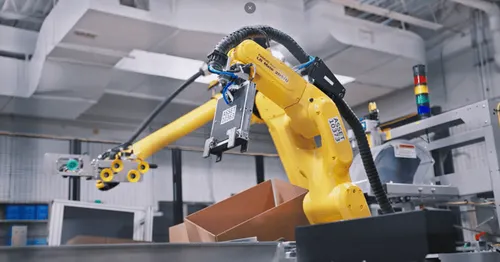
FANUC at IMTS 2026: Physical AI, Robotics and CNC Innovation Move Into the Factory
FANUC America is positioning IMTS 2026 as a showcase for the next stage of industrial…
How CNC Machines Improve Export Quality: From Precision Machining to Process Control
Global manufacturing is increasingly built around supply chains where components may be designed in one…

ANCA at IMTS 2026: New Leadership, Precision Tooling and the Next Manufacturing Shift
A new CEO. A legendary founder. One booth. And a manufacturing industry moving faster than…
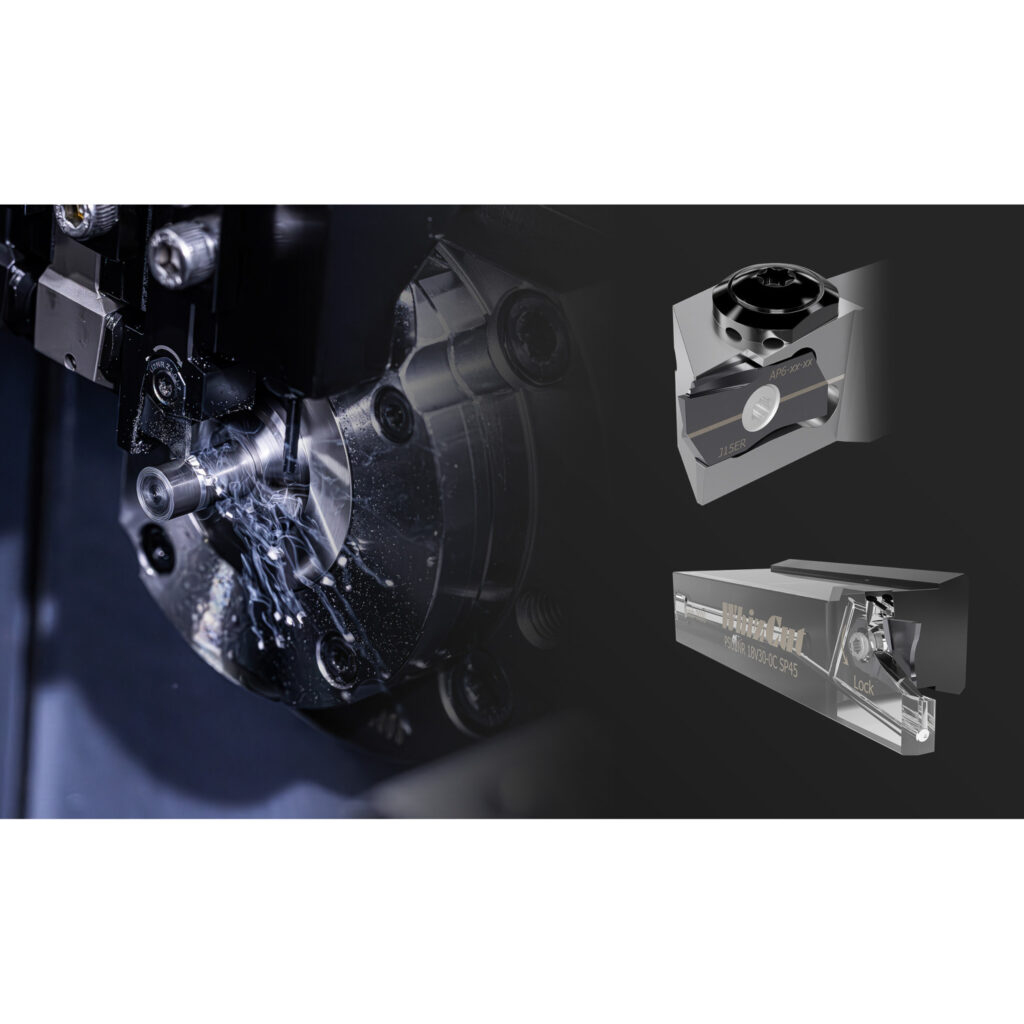
WhizCut at AMB Stuttgart 2026: Smarter Cutting Tools Target Material Waste, Productivity and Sustainable Machining
WhizCut is set to present its precision-tooling portfolio at AMB Stuttgart 2026, with products focused…