
Autonomous material handling is moving from pilot projects toward repeatable production workflows as Cyngn expands an existing deployment at a Fortune 100 heavy equipment manufacturer.
Published: October 4, 2026
Category: Robotics & Automation / Smart Manufacturing
Source: Robotics & Automation News / Cyngn
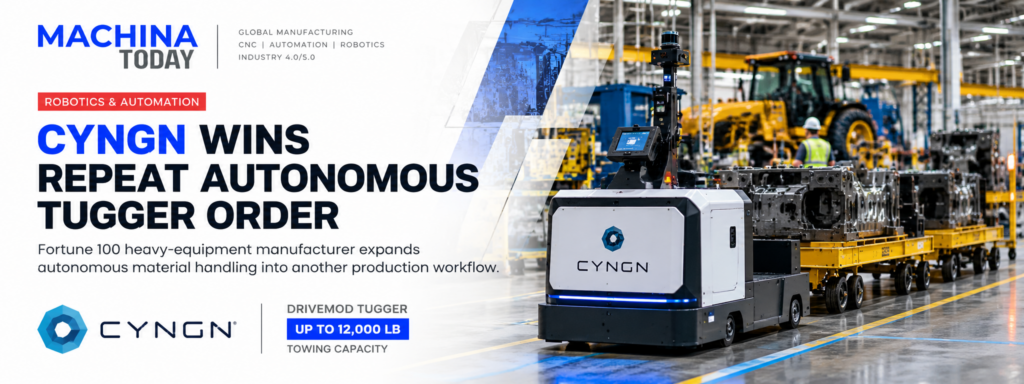
Cyngn has secured a follow-on order for its DriveMod Tugger from an existing Fortune 100 heavy equipment manufacturing customer, expanding autonomous material handling into another production workflow.
The customer has not been publicly identified, and Cyngn has not disclosed the financial value or number of vehicles involved in the order. According to Cyngn, the additional deployment will support the movement of components to a heavy-equipment assembly line.
From Initial Deployment to Expanded Automation
The significance of the announcement is not simply that another autonomous tugger has been ordered.
The bigger signal is that an existing industrial customer is expanding its use of autonomous material handling.
For manufacturers evaluating robotics and autonomous mobile systems, the transition from a first deployment to additional production workflows can be an important indicator of practical adoption.
Instead of attempting to automate an entire factory at once, manufacturers can start with a repetitive material-handling route, evaluate the operational results and then identify additional applications where autonomous transportation makes sense.
That is the model Cyngn is highlighting with this latest order.
What Will the Autonomous Tugger Do?
The new application will involve moving components to an assembly line inside the customer’s heavy-equipment manufacturing facility.
This is a classic industrial material-flow problem.
Components frequently need to move between different areas of a factory:
- Storage and production
- Kitting and assembly
- Sub-assembly and final assembly
- Warehousing and production lines
- Receiving and internal logistics areas
When these movements are repetitive and follow predictable routes, autonomous vehicles can become a potential automation layer.
Cyngn’s DriveMod Tugger is designed specifically for this type of repetitive industrial transportation.
DriveMod Tugger: Key Capability
According to Cyngn, the DriveMod Tugger is designed for repetitive material transport and can tow up to 12,000 pounds.
Its autonomous navigation technology is designed to allow suitable routes to be automated without installing fixed guidance infrastructure such as magnetic tape or guide wires.
That approach is particularly relevant for manufacturers that want to introduce autonomous transportation without completely redesigning their factory infrastructure.
Why Repeat Orders Matter
The manufacturing robotics market is increasingly shifting from demonstrations and proof-of-concept projects toward systems that operate as part of everyday production.
A repeat order can be meaningful because the customer has already gained experience with the technology, deployment environment and operational workflow.
In this case, Cyngn says the additional order builds on the manufacturer’s earlier adoption of its autonomous vehicle technology.
The company describes this expansion model as starting with a practical automation opportunity, establishing its value and then extending autonomous material movement into additional workflows or facilities.
The Bigger Manufacturing Trend
The announcement reflects a broader shift in industrial automation.
Factories are not only automating machining, welding, inspection and assembly. Increasingly, companies are also examining the movement of materials between those processes.
That matters because a highly automated production line can still depend on manually operated internal logistics.
Autonomous mobile robots, tugger systems and other autonomous industrial vehicles can potentially connect different production areas and create a more automated material-flow system.
The goal is not necessarily to replace every manual movement.
Instead, the opportunity is to identify repetitive routes where autonomous transportation can deliver measurable operational value.
What Manufacturers Should Watch
For manufacturing leaders, the interesting question is no longer simply:
“Can autonomous vehicles move materials?”
The more important question is:
“Where can autonomous material movement create measurable value inside our factory?”
Potential starting points include:
- High-frequency material routes
- Long-distance internal transportation
- Repetitive component deliveries
- Assembly-line replenishment
- Warehouse-to-production movement
- Routes where labor is heavily tied to transportation rather than value-added production
A successful deployment can then provide the operational experience needed to evaluate additional routes.
Machina Today Take
The Cyngn announcement is another example of how industrial autonomy is gradually moving toward workflow-level adoption.
The important signal is not the identity of the Fortune 100 manufacturer—it remains undisclosed.
It is the fact that an existing customer is extending autonomous material handling into another production workflow.
That is the kind of progression manufacturers will increasingly watch: pilot → production → expansion.
As factories become more connected, the next generation of smart manufacturing will depend not only on intelligent machines, but also on intelligent movement of materials between them.
The autonomous factory may not arrive as one giant transformation. It may arrive route by route.
Source & Editorial Credit
This Machina Today article is based on reporting published by Robotics & Automation News on October 4, 2026, and cross-checked against Cyngn’s official announcement dated September 29, 2026.
Original report: Robotics & Automation News — “Cyngn wins repeat autonomous tugger order from Fortune 100 manufacturer.”
Company source: Cyngn — “Cyngn Expands Autonomous Tugger Adoption with Fortune 100 Heavy Equipment Manufacturer.”
Machina Today independently edited and contextualized the information for its manufacturing audience. This article does not imply endorsement or partnership with Cyngn or Robotics & Automation News.
Cyngn Wins Repeat Autonomous Tugger Order from Fortune 100 Heavy Equipment Manufacturer
Autonomous material handling is moving from pilot projects toward repeatable production workflows as Cyngn expands…
Okuma America Corporation Appoints Summer Cline as New Chief Financial Officer
Summer Cline has been promoted to Chief Financial Officer (CFO) of Okuma America Corporation, strengthening…
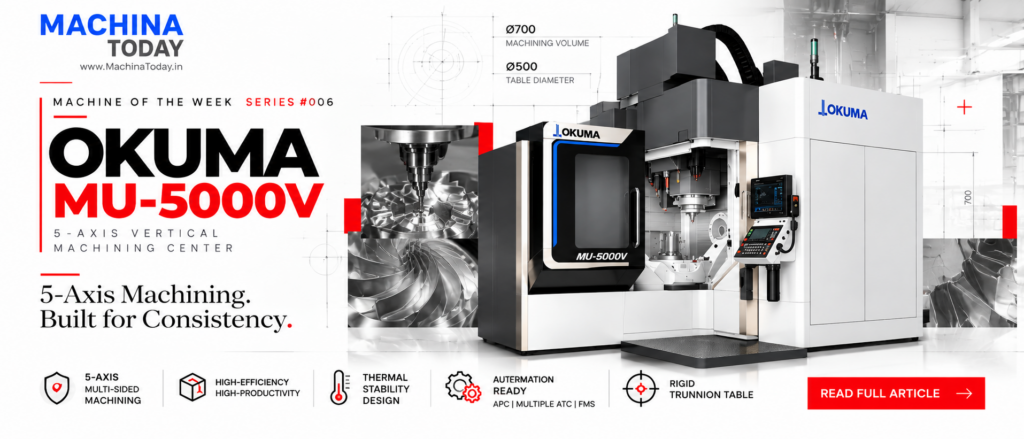
Okuma MU-5000V: 5-Axis CNC Machining Center for High-Precision Multi-Sided Machining
The Okuma MU-5000V is a 5-axis vertical machining center designed for high-efficiency, high-productivity multi-sided machining….
Five Million Industrial Robots Are Now Working in Factories — What It Means for Manufacturing
The global factory floor is becoming increasingly automated. According to the International Federation of Robotics…
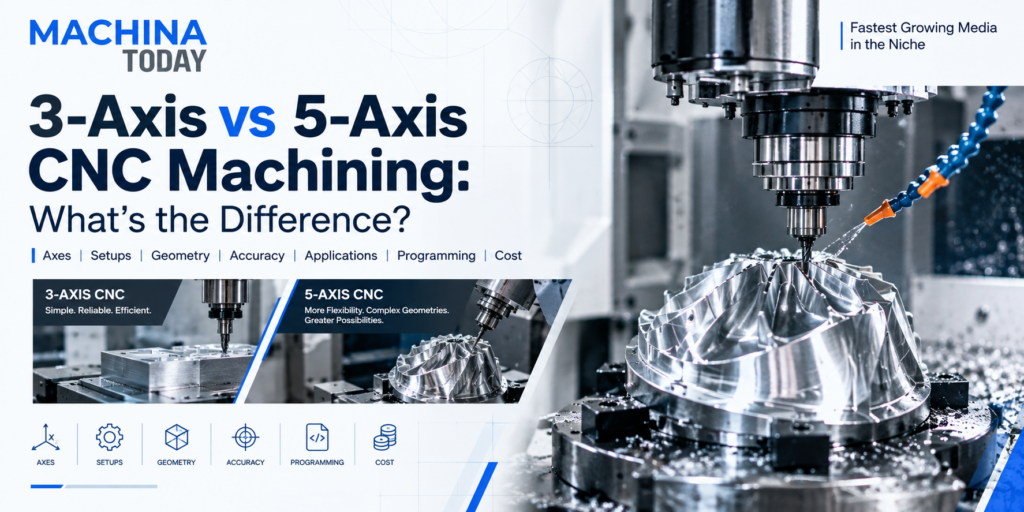
3-Axis vs 5-Axis CNC Machining: What’s the Difference?
3-axis vs 5-axis CNC machining is not simply a comparison between a basic machine and…
CNC Machining: Complete Guide to CNC Machines, Processes, Types and Applications
CNC machining is one of the foundations of modern manufacturing. From aerospace structures and automotive…