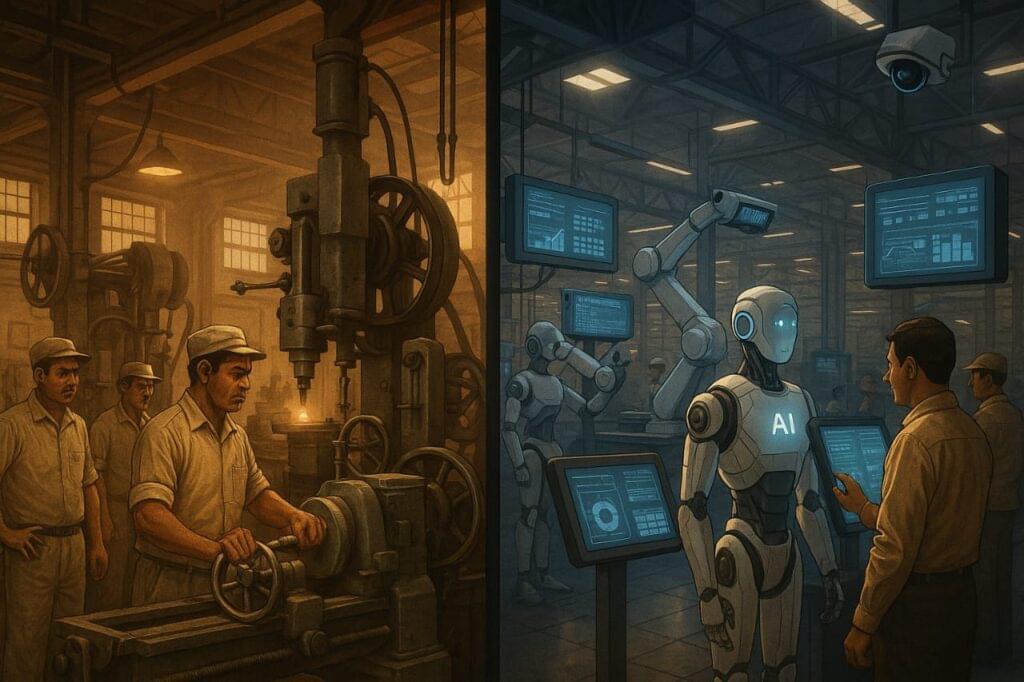

Quality Control (QC) is the backbone of any successful manufacturing operation. But in today’s age of smart factories, one question arises more often than ever:
Should we stick with Manual Quality Control or switch to AI-Based QC?
In this blog, we’ll break down the key differences, advantages, limitations, and ideal use cases of both methods—so you can decide what works best for your production line.
What is Manual Quality Control?
Manual QC involves human inspectors examining parts and products at various stages of the manufacturing process. This might include:
- Visual checks for defects, cracks, surface finish, etc.
- Measuring tools like calipers, micrometers, gauges.
- Checklists and SOPs followed by experienced personnel.
Used In: Traditional machining, casting, forging, assembly lines, etc.
What is AI-Based Quality Control?
AI-Based QC uses machine vision, deep learning, and sensors to automatically inspect and analyze parts. It often involves:
- High-speed cameras
- Neural networks trained on defect patterns
- Integration with PLCs, SCADA, and MES
Used In: Electronics, automotive, precision component industries, Industry 4.0 environments.
Comparison: Manual QC vs AI-Based QC
| Feature | Manual QC | AI-Based QC |
|---|---|---|
| Accuracy | Depends on operator skill; may vary | Consistent and high-precision |
| Speed | Slower, especially for large batches | High-speed, real-time inspection |
| Human Error | High possibility | Minimal to none |
| Initial Cost | Low | High investment (hardware + training) |
| Flexibility | Easily adapted to new products | Needs retraining of models |
| Data Logging | Manual records | Automated data capture and reports |
| Best For | Low-volume, custom parts | High-volume, repetitive production |
✅ Manual QC Pros:
- Low setup cost
- Easy to train new staff
- Good for customized or variable products
❌ Manual QC Cons:
- Fatigue-induced errors
- Lack of real-time insights
- Inconsistent results
✅ AI-Based QC Pros:
- Fast and reliable
- Scalable for Industry 4.0
- Detailed analytics & predictive insights
❌ AI-Based QC Cons:
- Requires upfront investment
- Needs skilled setup and training
- Less flexible for product variation
When Should You Use Manual QC?
- In small shops or job shops
- For handmade or highly customized products
- When budgets are tight
When Should You Use AI-Based QC?
- In mass production environments
- For critical components (aerospace, automotive)
- When aiming for zero-defect manufacturing
- When quality data is vital for reporting or compliance
Hybrid QC Systems: Best of Both Worlds?
Many companies are adopting hybrid models, where:
- AI handles 80-90% of repetitive checks, and
- Humans oversee exceptions and edge cases.
This ensures speed and flexibility while maintaining quality standards.
There’s no one-size-fits-all answer. Manual QC is still valuable in many contexts, but AI-Based QC is rapidly becoming essential for industries chasing efficiency, scalability, and precision.
Want to future-proof your quality process? Start by evaluating your current pain points and production goals. Sometimes, even small AI integrations (like machine vision for surface defects) can deliver major returns.

IMTS 2026 Opens in Chicago: AI, CNC, Robotics and Automation Take Center Stage
IMTS 2026 is officially underway in Chicago, bringing the global manufacturing technology industry together at…
Top Aerospace Manufacturing Technologies in 2026: 10 Technologies Reshaping How Aircraft Are Built
Aerospace manufacturing is entering a new industrial era. From AI-driven engineering and digital twins to…
FANUC at IMTS 2026: Physical AI, Robotics and CNC Innovation Move Into the Factory
FANUC America is positioning IMTS 2026 as a showcase for the next stage of industrial…
How CNC Machines Improve Export Quality: From Precision Machining to Process Control
Global manufacturing is increasingly built around supply chains where components may be designed in one…

ANCA at IMTS 2026: New Leadership, Precision Tooling and the Next Manufacturing Shift
A new CEO. A legendary founder. One booth. And a manufacturing industry moving faster than…
WhizCut at AMB Stuttgart 2026: Smarter Cutting Tools Target Material Waste, Productivity and Sustainable Machining
WhizCut is set to present its precision-tooling portfolio at AMB Stuttgart 2026, with products focused…