In the heart of every humming factory—amid the clang of metal, the whir of machines, and the bustle of workers—something remarkable is happening. Artificial Intelligence (AI), once a distant concept from sci-fi films, is now reshaping how real-world factories operate. And surprisingly, it’s not replacing people—it’s working alongside them.
🤖 What Is AI in Manufacturing?
AI in factories refers to the use of intelligent software and data-driven systems to optimize production. Think machine learning, predictive maintenance, computer vision, and autonomous robotics—all tuned to make machines smarter and humans more efficient.
But AI isn’t just about algorithms. It’s about giving factories a brain—and letting that brain learn, adapt, and assist in ways humans can’t do alone.
🔍 Why Is AI Entering the Factory Floor?
Because the world is moving faster.
📉 Downtime is expensive.
🕒 Speed to market is critical.
💰 Efficiency means survival.
In India, where MSMEs form the backbone of industrial output, AI offers a chance to leapfrog traditional automation—bringing smart insights into even the most modest of workshops.
- A welding robot now stops when it senses human presence.
- A smart camera flags defects in milliseconds.
- AI algorithms predict when a lathe will break—weeks in advance.
All of this means less waste, higher quality, and safer workplaces.
👷 The Human Touch in AI Factories
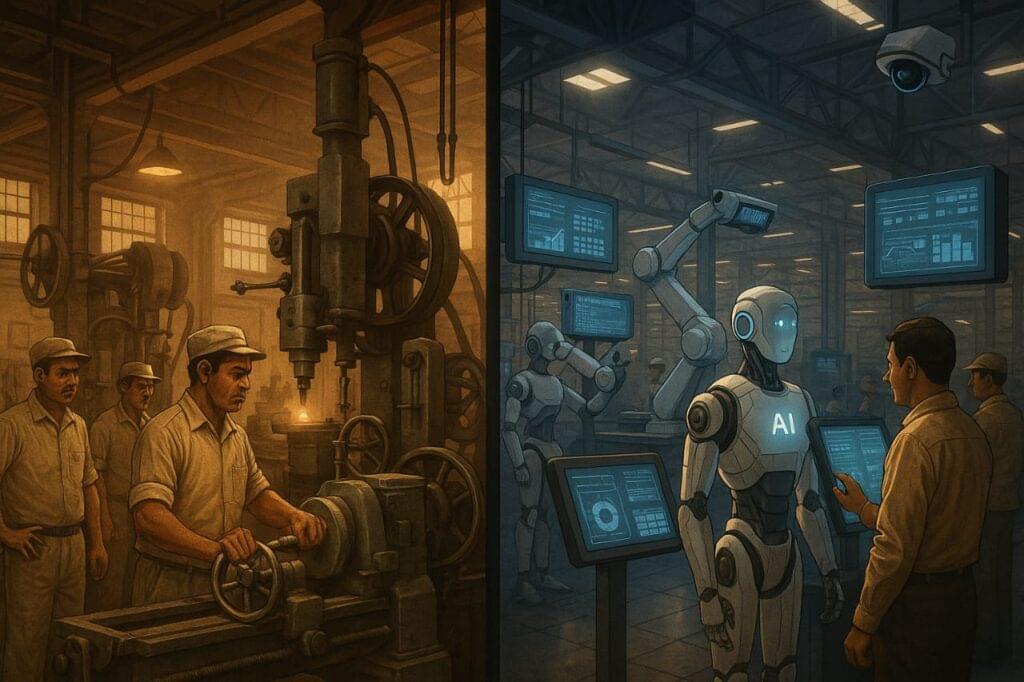
One of the biggest myths? That AI will replace humans. The reality is different.
Workers aren’t being pushed out—they’re being empowered.
- Operators learn to manage dashboards instead of just dials.
- Engineers become system thinkers, not just repairmen.
- Supervisors make decisions with real-time data, not guesswork.
In this new model, humans become augmented, not obsolete.
As one technician at a smart machine plant in Gujarat said,
“AI didn’t take my job. It made me 10x better at it.”
🌍 India’s Role in the Global Smart Factory Movement
India is quietly becoming a key player in the AI manufacturing shift. Startups in Pune, Chennai, and Bengaluru are creating AI platforms tailored for Indian conditions—dusty environments, unpredictable power, and highly skilled operators.
Government-backed programs like SAMARTH Udyog and private initiatives by firms like Tata, Bharat Forge, and Macpower CNC are pushing AI deeper into the factory ecosystem.
We’re witnessing the rise of the Indian Smart Factory—one data point, one algorithm, one human decision at a time.
🔄 The Future: Collaborative, Not Robotic
AI in factories isn’t about cold, robotic efficiency. It’s about collaboration—between man and machine. Between raw material and digital intelligence.
And at the center of it all is a factory worker, not replaced, but reimagined.
🧠 Final Thoughts
As we step into the next era of industrial growth, AI in manufacturing isn’t just a trend—it’s a necessity. But more importantly, it’s an opportunity to build factories that are smarter, safer, and more human than ever before.
IMTS 2026 Opens in Chicago: AI, CNC, Robotics and Automation Take Center Stage
IMTS 2026 is officially underway in Chicago, bringing the global manufacturing technology…
Top Aerospace Manufacturing Technologies in 2026: 10 Technologies Reshaping How Aircraft Are Built
Aerospace manufacturing is entering a new industrial era. From AI-driven engineering and…
FANUC at IMTS 2026: Physical AI, Robotics and CNC Innovation Move Into the Factory
FANUC America is positioning IMTS 2026 as a showcase for the next…
How CNC Machines Improve Export Quality: From Precision Machining to Process Control
Global manufacturing is increasingly built around supply chains where components may be…
ANCA at IMTS 2026: New Leadership, Precision Tooling and the Next Manufacturing Shift
A new CEO. A legendary founder. One booth. And a manufacturing industry…
WhizCut at AMB Stuttgart 2026: Smarter Cutting Tools Target Material Waste, Productivity and Sustainable Machining
WhizCut is set to present its precision-tooling portfolio at AMB Stuttgart 2026,…