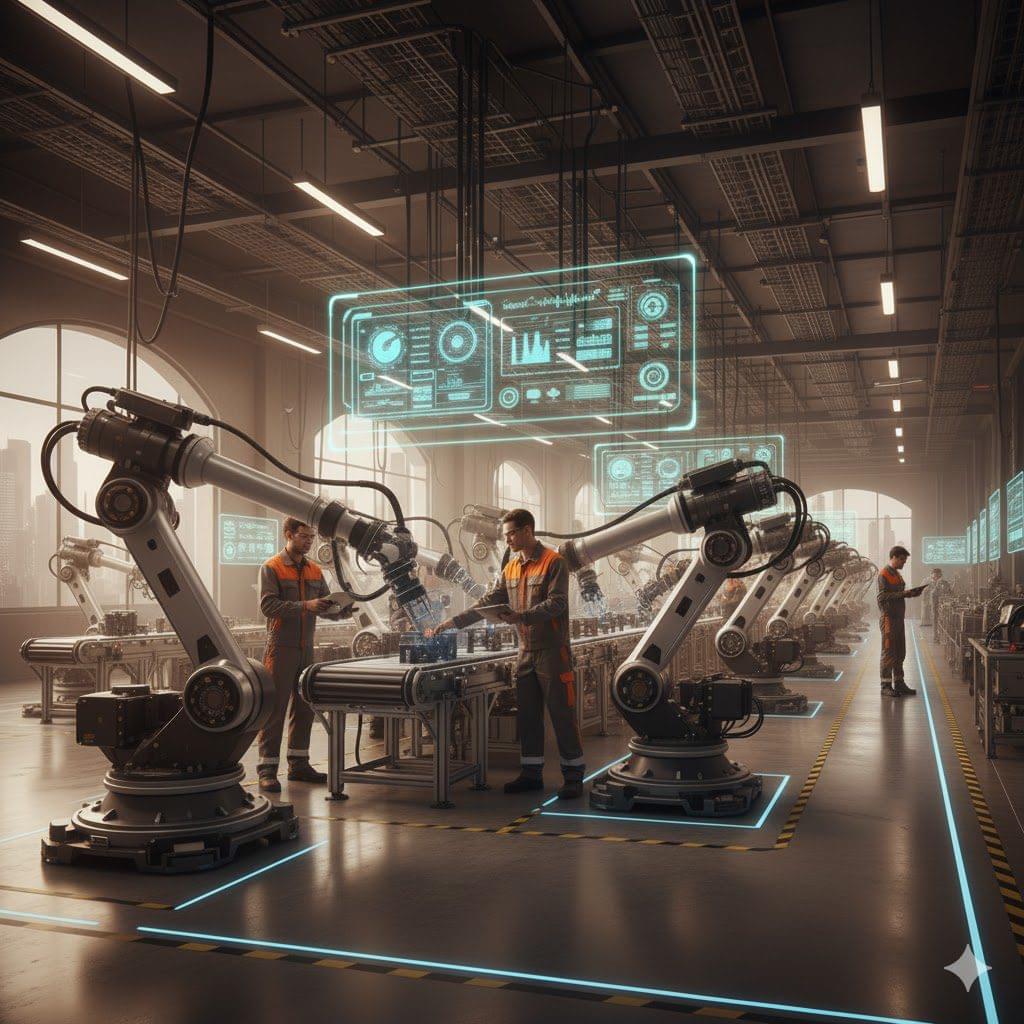
Imagine a robot that doesn’t replace workers — but works with them.
Welcome to the era of Collaborative Robots, or Cobots, where automation meets human intelligence to build the factories of the future.
Unlike traditional industrial robots locked behind safety cages, cobots are designed to safely collaborate with humans, boosting productivity, quality, and efficiency without compromising safety.
What Are Collaborative Robots (Cobots)?
Cobots are lightweight, flexible, and intelligent robots that assist human operators in performing repetitive or complex tasks.
They come equipped with advanced sensors, force control, and AI algorithms that allow them to adapt to changing environments and work safely alongside people.
Why Cobots Are Transforming Manufacturing
- 🤝 Human-Robot Collaboration:
Cobots handle heavy or repetitive work while humans focus on creative and decision-based tasks. - ⚙️ Easy to Program and Deploy:
Most cobots can be set up within hours using intuitive drag-and-drop interfaces. - 💡 Cost-Effective for SMEs:
Cobots don’t require safety cages or large floor space, making them ideal for small and medium manufacturers. - 📈 Improved Productivity:
With 24/7 operation capability, cobots help achieve consistent output and higher efficiency.
Key Industries Using Cobots
- Automotive: Assembly, painting, welding, and inspection.
- Electronics: Precision component handling and testing.
- Packaging: Palletizing, labeling, and sorting.
- Metalworking: Machine tending, polishing, and welding.
- Pharmaceuticals: Sterile handling and filling applications.
Cobots vs Traditional Robots
| Feature | Traditional Robots | Collaborative Robots |
|---|---|---|
| Safety | Require cages & barriers | Work safely beside humans |
| Programming | Complex | User-friendly & fast |
| Cost | High initial investment | Affordable for SMEs |
| Flexibility | Fixed to one task | Easily reprogrammable |
Indian Manufacturing and Cobots
India is fast adopting cobots to bridge the skill gap and labor shortage in precision manufacturing.
Companies in Pune, Chennai, and Ahmedabad are integrating Universal Robots, ABB YuMi, and Doosan cobots into their assembly lines to enhance safety and efficiency.
This shift marks India’s transition toward Industry 5.0, where human creativity and robotic precision work hand in hand.
Future of Cobots: Beyond Automation
Next-gen cobots will come equipped with AI vision systems, gesture recognition, and self-learning capabilities.
They will not just follow instructions — they’ll understand intent and make autonomous micro-decisions.
As Industry 5.0 unfolds, cobots will become trusted teammates, not tools — helping factories achieve balance between technology, efficiency, and humanity.
The rise of collaborative robots signifies a new industrial era — one that’s human-centric, intelligent, and sustainable.
By embracing cobots, manufacturers can boost efficiency while empowering their workforce to focus on innovation and creativity, not repetition.

IMTS 2026 Opens in Chicago: AI, CNC, Robotics and Automation Take Center Stage
IMTS 2026 is officially underway in Chicago, bringing the global manufacturing technology industry together at…
Top Aerospace Manufacturing Technologies in 2026: 10 Technologies Reshaping How Aircraft Are Built
Aerospace manufacturing is entering a new industrial era. From AI-driven engineering and digital twins to…
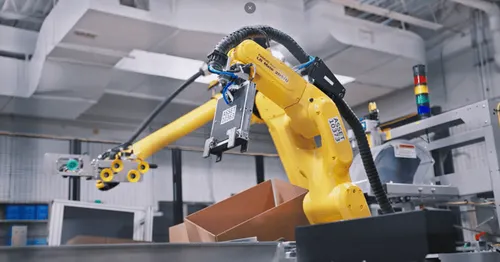
FANUC at IMTS 2026: Physical AI, Robotics and CNC Innovation Move Into the Factory
FANUC America is positioning IMTS 2026 as a showcase for the next stage of industrial…
How CNC Machines Improve Export Quality: From Precision Machining to Process Control
Global manufacturing is increasingly built around supply chains where components may be designed in one…

ANCA at IMTS 2026: New Leadership, Precision Tooling and the Next Manufacturing Shift
A new CEO. A legendary founder. One booth. And a manufacturing industry moving faster than…
WhizCut at AMB Stuttgart 2026: Smarter Cutting Tools Target Material Waste, Productivity and Sustainable Machining
WhizCut is set to present its precision-tooling portfolio at AMB Stuttgart 2026, with products focused…
我很少遇到, 这么生动的旅行故事。谢谢。
衷心感谢 有用的内容。十分 激励人。 [url=https://iqvel.com/zh-Hans/a/%E4%BF%84%E7%BD%97%E6%96%AF/%E9%98%BF%E5%8D%A2%E6%99%AE%E5%8D%A1%E5%85%AC%E5%9B%AD]花壇雕塑[/url] 我喜欢, 充满真情实感。你的博客 就是 关于这些的。请继续。