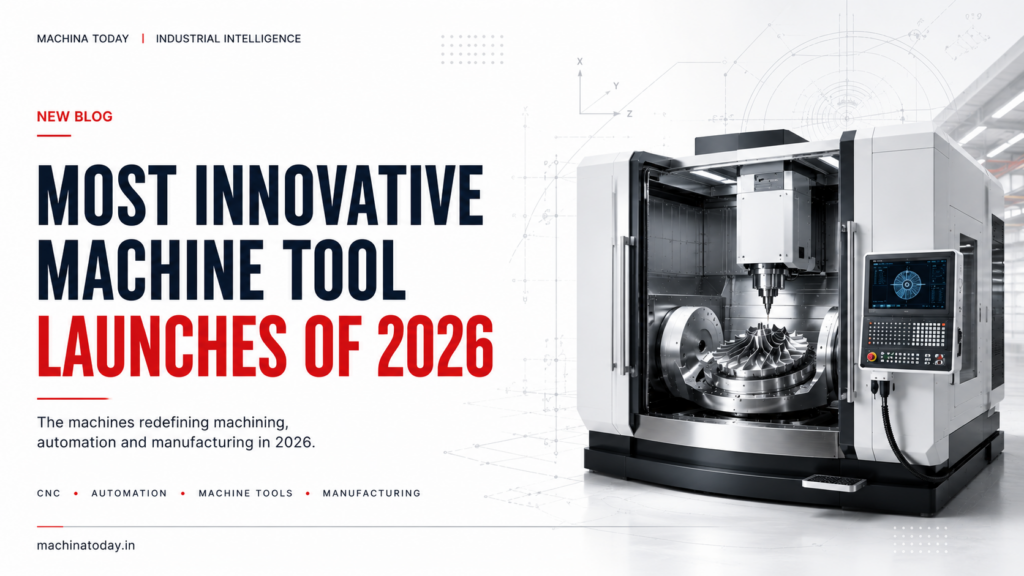
The most interesting machine-tool launches of 2026 are not necessarily the machines with the biggest spindle or the longest list of specifications.
Something more important is happening.
Machine builders are increasingly trying to solve the problems that manufacturers actually face on the shop floor: shortage of skilled workers, rising production costs, increasingly complex parts, multiple setups, unpredictable process conditions and pressure to produce more with less labor.
That is changing what a “new CNC machine” means.
In 2026, innovation is moving beyond simply making a machine faster. Manufacturers are integrating 5-axis machining, multitasking, automation, additive manufacturing, digital twins, intelligent controls and process monitoring into increasingly complete production systems.
And the timing is significant.
IMTS 2026 in Chicago is scheduled for September 14–19 and is expected to feature more than 1.2 million square feet of exhibition space and more than 1,800 exhibitors. The organizers have already confirmed that companies including Okuma, INDEX, Tsugami, Mazak, Matsuura, Haas, JTEKT, Marubeni Citizen-Cincom and DN Solutions plan to introduce new multitasking, multifunction, hybrid and 5-axis machines.
So, which machines deserve attention?
Here are the launches and major 2026 debuts that we believe tell the clearest story about where machine-tool technology is heading.
1. DMG MORI NMV 3000 / 5000 DCG 2nd Generation
A 5-axis machine designed around process integration
One of the clearest machine launches of 2026 so far comes from DMG MORI with the NMV 3000 / 5000 DCG 2nd Generation.
The company officially launched the second-generation 5-axis vertical machining centers in March 2026.
The significance isn’t simply that these are new 5-axis machines.
The NMV platform was originally introduced in 2006 around the idea of consolidating processes that previously required multiple machines. DMG MORI says the latest generation continues that philosophy for industries including aerospace, die and mold, semiconductor and mobility manufacturing.
That makes this launch particularly interesting.
A manufacturer producing a complex component doesn’t necessarily need another machine with another axis. It needs fewer setups, fewer transfers and fewer opportunities for error.
That is where advanced 5-axis machining becomes commercially interesting.
Why it matters in 2026:
- Complex parts can be consolidated into fewer operations.
- 5-axis machining reduces repeated workholding changes.
- It addresses labor and skill shortages.
- It targets high-precision industries.
- It fits directly into the wider shift toward process integration.
Machina Today take:
The important innovation here isn’t “five axes.” Five-axis machining has been around for decades. The innovation is how machine builders are making process consolidation a central part of the machine’s value proposition.
2. Okuma MB-100V
Big-machine capability meets automation
Okuma is preparing one of the more interesting machine-tool lineups for IMTS 2026.
Among its four machines making their Americas debut is the new MB-100V vertical machining center.
The machine has a particularly large working envelope, with approximately 126 inches of X travel, 49.2 inches of Y travel and 29.5 inches of Z travel. Okuma lists a 13,200-pound table load capacity and a CAT50 BIG-PLUS spindle reaching 12,000 rpm.
This is a very different proposition from the compact VMCs dominating many job-shop discussions.
The MB-100V is aimed at manufacturers dealing with large components where size, rigidity and production capability matter.
And this is where 2026’s machine-tool story gets interesting.
Automation isn’t only about small parts anymore.
Large machines are increasingly being designed with automation, digital control and production-flow considerations in mind.
Why it matters:
- Large-format machining remains critical for aerospace, energy and industrial equipment.
- Higher automation is moving into traditionally difficult applications.
- Large workpieces create significant material-handling challenges.
- Machine size alone is no longer the complete productivity equation.
3. Okuma MULTUS U1000
The mill-turn machine continues to eat into traditional process boundaries
The MULTUS U1000 is another important Okuma 2026 machine debut.
It is a multitasking lathe designed to combine turning and milling operations in a single platform.
According to Okuma’s published IMTS specifications, the U1000 features a 6,000-rpm main spindle, 6,000-rpm sub-spindle and 12,000-rpm milling spindle, along with an 80-tool capacity. Its B-axis provides 240 degrees of movement while the C-axis provides 360 degrees.
Why does that matter?
Because the manufacturing industry is gradually moving away from the mentality of:
Turn → transfer → fixture → mill → inspect → transfer again.
The goal is increasingly:
Load → machine → finish.
Every additional setup creates another opportunity for positioning error, handling time and work-in-progress.
That is why multitasking machines remain one of the strongest machine-tool trends of 2026.
4. INDEX TRAUB MS12-4
Four machines’ worth of thinking in one multi-spindle concept
INDEX is bringing something particularly unusual to IMTS 2026: the TRAUB MS12-4 CNC multi-spindle machine.
INDEX describes it as an entirely new machine concept.
The North American debut combines the functionality of four TRAUB TNL12 single-spindle sliding-headstock lathes into one machine.
That deserves attention because it challenges a basic assumption in production machining.
More output doesn’t always mean buying more individual machines.
Sometimes the better answer is to fundamentally rethink the machine architecture.
For high-volume precision components, multi-spindle technology can potentially reduce floor-space requirements while increasing production density.
Why this launch stands out:
- New machine architecture rather than incremental improvement.
- Targets high-volume precision production.
- Combines multiple machining concepts.
- Addresses floor-space and labor efficiency.
- Shows how machine builders are thinking about production density.
Machina Today take:
This may be one of the most interesting machines to watch at IMTS because it represents rethinking the production cell itself, rather than simply adding another feature to a conventional CNC.
5. Matsuura LUMEX Avance-25
When additive manufacturing and CNC machining become one process
Not every major machine-tool innovation of 2026 is purely subtractive.
Matsuura Machinery USA is showcasing the LUMEX Avance-25 at IMTS 2026.
The system combines metal additive manufacturing and precision machining within a single platform. Matsuura says the concept is aimed at producing highly complex components while reducing the number of manufacturing steps.
This is significant for applications where conventional machining alone struggles with complex internal geometries.
Instead of thinking of additive and subtractive manufacturing as competing technologies, hybrid machines treat them as complementary processes.
That opens possibilities for:
- Complex internal channels
- Difficult geometries
- Reduced part handling
- Integrated additive/subtractive workflows
- Greater design freedom
The bigger story is that hybrid manufacturing is becoming less experimental and more production-oriented.
6. Makino DA500
Five-axis machining focused on production, not just capability
Makino’s DA500 is another machine worth watching in 2026.
The high-speed production-oriented 5-axis machining center is designed for milling, drilling, tapping and turning operations, with the ability to consolidate more work into a single setup.
Makino lists a 20,000-rpm HSK-A63 spindle with 50% more torque, twice the power and one-third the acceleration time compared with the previous configuration it highlights. The machine also incorporates technologies including Vision Systems, Super Geometric Intelligence (SGI.5), Inertia Active Control and Collision Safeguard.
This is where modern CNC development is becoming increasingly interesting.
The machine is not simply being optimized mechanically.
The machine’s sensing, software and control architecture are becoming part of the productivity equation.
That is one of the defining characteristics of the modern machine tool.
7. Hartford SMC-7
High-speed drilling and tapping for a labor-constrained world
Taiwanese machine-tool manufacturer Hartford launched the SMC-7 in May 2026 as a next-generation high-speed drilling and tapping machining center.
Hartford positions the machine around high-volume production, precision machining and automated manufacturing, explicitly linking its development to rising production demands, labor shortages and pressure to improve machine utilization.
This is worth highlighting because not every innovation needs to involve five axes or hybrid manufacturing.
Sometimes the most valuable innovation is simply making a machine extremely good at the job it is supposed to do.
For electronics, automotive components, precision parts and other high-volume applications, cycle time and repeatability can matter more than maximum flexibility.
8. Mazak VC-Ez 20
Making advanced CNC capability more accessible
Mazak’s VC-Ez 20 is an interesting example of another 2026 trend: making advanced manufacturing capability more accessible to smaller and mid-sized manufacturers.
Mazak says the Kentucky-designed and built machine features a 40-taper, 12,000-rpm, 25-hp spindle as standard, with an optional 15,000-rpm, 29.5-hp spindle. It can also be configured with a 30- or 50-tool automatic tool changer.
The machine is also designed around easier installation, operation and automation integration.
That matters because the future of CNC manufacturing isn’t only about aerospace giants and Tier-1 automotive suppliers.
Small and medium-sized manufacturers increasingly need technology that can deliver higher productivity without requiring an army of highly specialized operators.
9. Okuma GENOS M4000H-e
Horizontal machining with automation built into the conversation
Another Okuma machine making its Americas debut at IMTS 2026 is the GENOS M4000H-e.
Okuma describes it as a high-speed, thermally stable horizontal machining center, designed for both aluminum machining and more demanding steel cutting.
The machine is being displayed with an integrated two-station automatic pallet changer.
The significance is less about the machine in isolation and more about how it fits into the wider production architecture.
At IMTS, Okuma says 9 of its 11 CNC machines will be paired with automation systems.
That is an important signal.
Automation is no longer being treated as something that gets added after buying the machine.
Increasingly, the machine and automation system are being designed as one production solution.
10. Nidec Machine Tool’s NC Twin
The machine tool is becoming a digital object before it becomes a physical one
Strictly speaking, Nidec NC Twin isn’t a machine tool launch.
But leaving it out of a 2026 machine-tool innovation story would miss one of the most important developments around machine tools.
Nidec Machine Tool launched Nidec NC Twin in July 2026 as a digital-twin platform for its MVR Series double-column machining centers.
The system recreates machine movements and machining processes virtually so manufacturers can validate programs before running them on the physical machine.
This changes the question from:
“Can this machine cut the part?”
to:
“Can we prove the process before the machine cuts the part?”
That difference matters.
Every minute spent proving out a machine is machine time that isn’t being used for production.
Digital twins can potentially move more of that work into a virtual environment.
What These 2026 Machine Tool Launches Have in Common
Looking at these machines individually is interesting.
Looking at them together is much more revealing.
There are five major trends connecting the most important machine-tool developments of 2026.
1. 5-axis is becoming mainstream
Five-axis machining is no longer reserved exclusively for exotic aerospace applications.
DMG MORI, Makino, Okuma and other manufacturers are increasingly using 5-axis technology to reduce setups and consolidate processes.
The goal isn’t simply more axes.
It’s fewer operations.
2. Automation is becoming part of the machine
Okuma’s IMTS lineup is a good example.
The company says 9 of its 11 machines will be paired with automation systems.
That tells us something important.
Manufacturers are not necessarily asking:
“Should I automate this CNC?”
They are increasingly asking:
“How much of this CNC cell can operate without an operator standing beside it?”
3. Machine tools are becoming software-defined systems
Digital twins, intelligent controls, collision avoidance, process monitoring and adaptive machining are becoming increasingly important.
DMG MORI’s Adaptive Drilling Control, for example, is designed to actively monitor and control demanding drilling processes rather than leaving the process entirely dependent on operator experience.
That is a fundamental shift.
The machine is beginning to understand more about its own process.
4. Hybrid manufacturing is moving forward
The LUMEX Avance-25 demonstrates how additive and subtractive processes can be brought together.
For complex components, the winning machine may not be the one that cuts fastest.
It may be the machine that can create, machine and finish the component with fewer process transfers.
5. The real battle is productivity per person
This may be the biggest trend of all.
Labor shortages are changing the economics of machine tools.
A machine that requires an operator for every setup, inspection and material movement may have impressive specifications but still struggle economically.
The most interesting 2026 machines are therefore designed around:
Machine + automation + software + process knowledge.
That is the real machine-tool transformation.
What About IMTS 2026?
This is where the 2026 story gets even more interesting.
IMTS has already confirmed that manufacturers including Okuma, INDEX, Tsugami, Mazak, Matsuura, Haas, JTEKT, Marubeni Citizen-Cincom and DN Solutions plan to introduce new multitasking, multifunction, hybrid or 5-axis technologies at the show.
IMTS 2026 is scheduled for September 14–19 in Chicago and will occupy more than 1.2 million square feet, with more than 1,800 exhibitors expected.
That means this list is not the final word on 2026.
In fact, the second half of the year could produce some of the biggest machine-tool stories.
For Machina Today readers, that makes September particularly important.
The Bigger Question: What Will the CNC Machine of 2030 Look Like?
If the machines launched and announced in 2026 are any indication, the CNC machine of the future won’t simply be a faster version of today’s machining center.
It will be more likely to:
- Machine multiple faces in one setup
- Automatically load and unload parts
- Monitor its own processes
- Simulate programs before production
- Adjust processes using real-time data
- Combine additive and subtractive manufacturing
- Connect with other machines
- Share production data with factory software
- Require less manual intervention
- Support less-experienced operators
And perhaps most importantly, it will become part of a connected production system rather than an isolated machine.
That is why the most innovative machine-tool launches of 2026 are worth watching.
The real innovation isn’t always visible from the outside.
Sometimes it’s hidden in the control.
Sometimes it’s in the automation.
Sometimes it’s in the software.
And sometimes it’s in the decision to combine processes that previously required three different machines.
Our Take: The Most Important Innovation Isn’t Another Axis
If we had to summarize the 2026 machine-tool landscape in one sentence, it would be this:
The machine tool is evolving from a cutting machine into an intelligent production system.
Five-axis machining, multitasking, automation, hybrid manufacturing and digital twins are all pieces of the same puzzle.
Manufacturers don’t ultimately buy axes.
They buy capacity, repeatability, uptime, flexibility and profitability.
That is the lens through which the next generation of CNC machines should be judged.
And 2026 may be remembered as one of the years when that transition became impossible to ignore.
Frequently Asked Questions
What are the most innovative machine tool launches of 2026?
Among the notable 2026 launches and major announced debuts are the DMG MORI NMV 3000/5000 DCG 2nd Generation, Okuma MB-100V, Okuma MULTUS U1000, INDEX TRAUB MS12-4, Matsuura LUMEX Avance-25, Makino DA500, Hartford SMC-7 and Mazak VC-Ez 20.
Which new CNC machines are launching at IMTS 2026?
IMTS has announced that new multitasking, multifunction, hybrid and 5-axis machines will be introduced by companies including Okuma, INDEX, Tsugami, Mazak, Matsuura, Haas, JTEKT, Marubeni Citizen-Cincom and DN Solutions.
What is the biggest CNC trend in 2026?
The strongest common trend is process integration. Manufacturers are combining 5-axis machining, multitasking, automation, digital technologies and inspection to reduce setups, labor requirements and production time.
Are 5-axis CNC machines becoming more common?
Yes. 5-axis machining is increasingly being applied beyond traditional aerospace and mold applications because it can reduce setups and enable complex components to be machined more efficiently.
What is hybrid manufacturing?
Hybrid manufacturing combines two or more manufacturing processes in one system. In the case of Matsuura’s LUMEX Avance-25, metal additive manufacturing is integrated with precision machining.
Why are digital twins important for CNC machining?
Digital twins allow manufacturers to simulate machine movements and manufacturing processes before running them on the physical machine. Nidec’s NC Twin is an example developed specifically for machining-center applications.
What should manufacturers look for when buying a CNC machine in 2026?
Manufacturers should look beyond spindle speed and axis travel. Important considerations include automation capability, machine utilization, process integration, thermal stability, control software, service support, tool management, inspection, digital connectivity and total cost of ownership.
Final Verdict
2026 isn’t simply producing new CNC machines. It is producing a new definition of what a CNC machine should be.
The winners will not necessarily be the machines with the most impressive specification sheet.
They will be the machines that help manufacturers produce more parts, with fewer setups, fewer people, less downtime and greater consistency.
And that is the real innovation to watch.
This article will be updated as manufacturers officially announce additional 2026 machine launches and as IMTS 2026 reveals new machines on the show floor.
Editor’s Note
This article was researched and fact-checked using manufacturer announcements, official product pages, and official exhibition information available as of August 7, 2026.
To maintain accuracy, Machina Today distinguishes between machines officially launched in 2026, machines making their 2026 regional or Americas debut, and established machines being showcased with new technologies or configurations in 2026. We do not describe an existing machine as a “2026 launch” simply because it is being exhibited in 2026.
Technical specifications, capabilities, application areas, and performance figures are based on information published by the respective manufacturers. Where manufacturers describe performance using test conditions, example workpieces, or specific configurations, those figures should not be interpreted as universal production results.
Machine-tool specifications can vary by market, configuration, options, and customer requirements. Readers should therefore verify final specifications, availability, pricing, and configuration directly with the machine builder or authorized distributor before making purchasing decisions.
Our goal at Machina Today is simple: report what is actually happening in manufacturing without turning manufacturer marketing claims into facts.
This article may be updated as additional machine launches, regional debuts, and official IMTS 2026 announcements are released.

IMTS 2026 Opens in Chicago: AI, CNC, Robotics and Automation Take Center Stage
IMTS 2026 is officially underway in Chicago, bringing the global manufacturing technology industry together at…

Top Aerospace Manufacturing Technologies in 2026: 10 Technologies Reshaping How Aircraft Are Built
Aerospace manufacturing is entering a new industrial era. From AI-driven engineering and digital twins to…
FANUC at IMTS 2026: Physical AI, Robotics and CNC Innovation Move Into the Factory
FANUC America is positioning IMTS 2026 as a showcase for the next stage of industrial…
How CNC Machines Improve Export Quality: From Precision Machining to Process Control
Global manufacturing is increasingly built around supply chains where components may be designed in one…

ANCA at IMTS 2026: New Leadership, Precision Tooling and the Next Manufacturing Shift
A new CEO. A legendary founder. One booth. And a manufacturing industry moving faster than…
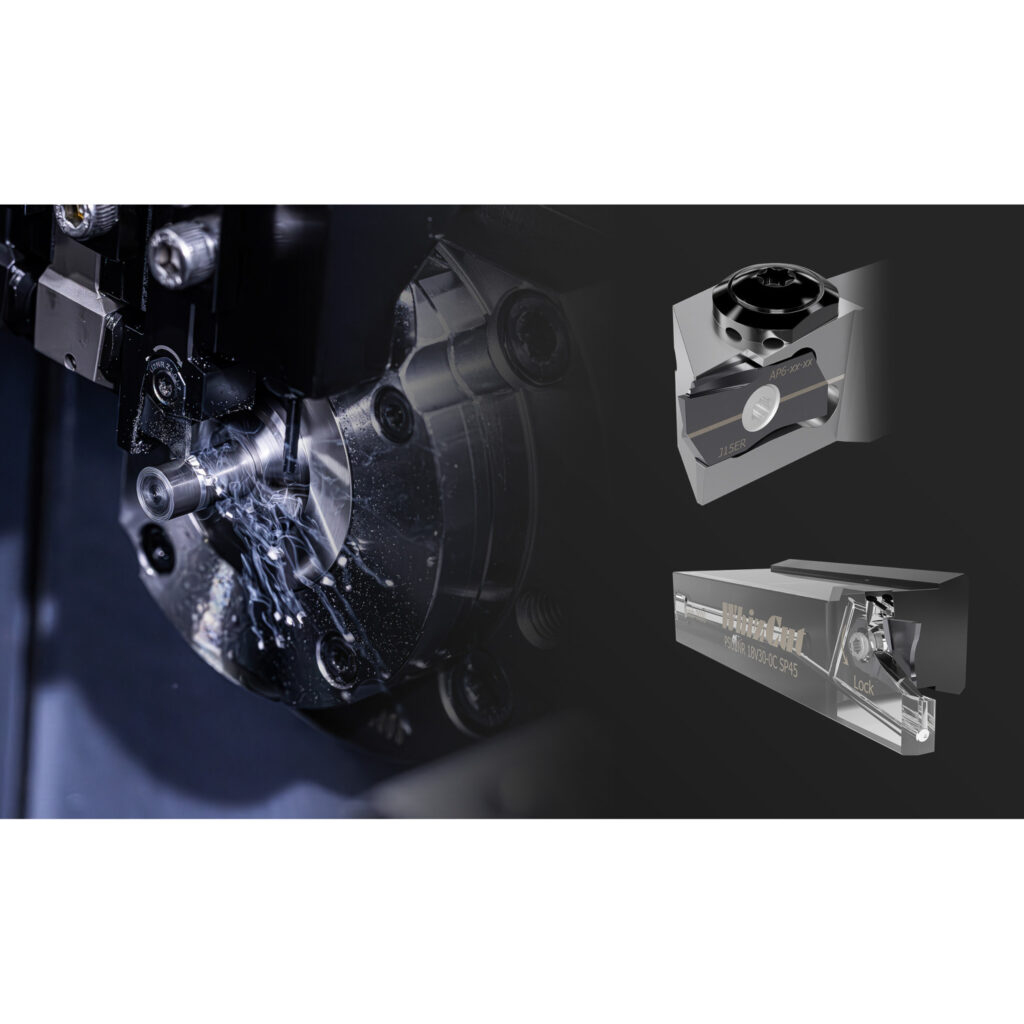
WhizCut at AMB Stuttgart 2026: Smarter Cutting Tools Target Material Waste, Productivity and Sustainable Machining
WhizCut is set to present its precision-tooling portfolio at AMB Stuttgart 2026, with products focused…