
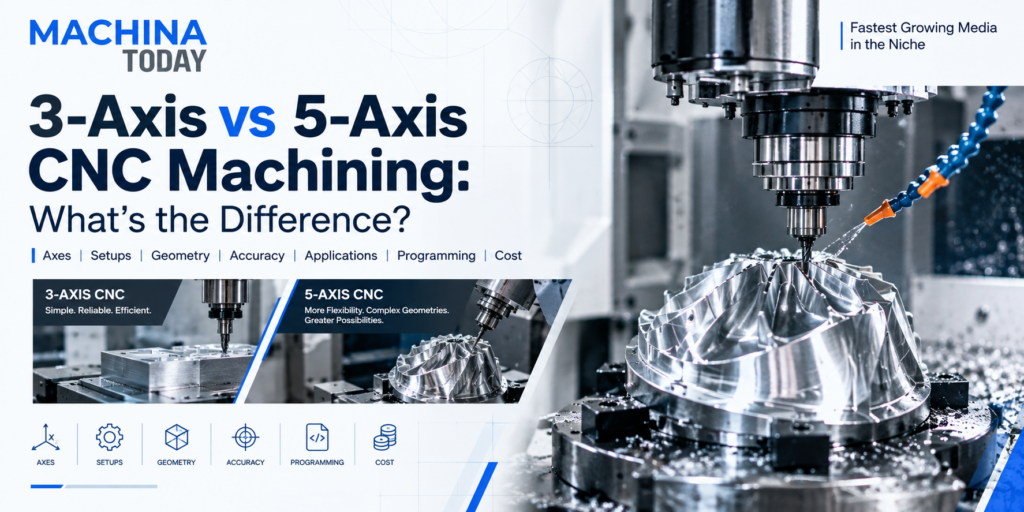
3-axis vs 5-axis CNC machining is not simply a comparison between a basic machine and a more advanced machine. The real difference is how the cutting tool and workpiece can be oriented to reach the required geometry.
A 3-axis CNC machine moves along the X, Y and Z linear axes, making it highly effective for plates, brackets, pockets, housings and other relatively accessible geometries. A 5-axis CNC machine adds two rotary axes, allowing the tool or workpiece to tilt and rotate so that multiple faces, angled features and complex contours can be machined with fewer setups.
The important question is not “Is 5-axis better than 3-axis?” It is:
Which machining process can manufacture the part accurately, efficiently and economically with the required tool access and the fewest unnecessary setups?
For simple prismatic components, 3-axis machining can remain highly productive and economical. For complex aerospace, medical, automotive, energy and die/mold components, 5-axis machining can reduce setups and improve access to difficult geometry.
3-Axis vs 5-Axis CNC Machining: Quick Answer
3-axis CNC machining uses X, Y and Z linear movement. It is generally suited to parts whose important features can be accessed from relatively straightforward directions.
5-axis CNC machining adds two rotary axes. Depending on the machine configuration, the table, workpiece, spindle head or a combination can rotate and tilt, giving the cutting tool substantially greater access to the component.
The simplest distinction:
3-axis: Move in X + Y + Z.
5-axis: Move in X + Y + Z + two rotary axes.
However, the number of axes alone does not determine machining quality. Machine construction, control, CAM software, tooling, workholding, calibration, programming and operator skill all influence the final result.
3-Axis vs 5-Axis CNC Machining: Comparison Table
| Factor | 3-Axis CNC | 5-Axis CNC |
|---|---|---|
| Linear axes | X, Y, Z | X, Y, Z |
| Rotary axes | None | 2 additional rotary axes |
| Typical geometry | Prismatic/simple | Complex, angled and contoured |
| Workpiece orientation | Usually fixed per setup | Can be tilted/rotated |
| Number of setups | Can increase for multi-sided parts | Often reduced |
| Programming | Generally simpler | More complex |
| CAM requirements | 3-axis toolpaths | Advanced multi-axis toolpaths |
| Tool access | More limited | Much greater |
| Complex surfaces | Possible, but may require more operations | Particularly suitable |
| Deep cavities | May require long tools | Better tool orientation can reduce reach |
| Surface finishing | Good for suitable geometry | Can improve tool orientation on complex surfaces |
| Machine investment | Generally lower | Generally higher |
| Operator/programming requirements | Lower | Higher |
| Best use | Simple to moderately complex parts | Complex multi-sided/contoured parts |
The practical differences above are consistent with current CNC machining guidance comparing geometry, setup strategy, programming and total process cost.
What Is 3-Axis CNC Machining?
A 3-axis CNC machine controls movement along three linear axes:
- X-axis: left to right
- Y-axis: front to back
- Z-axis: up and down
The cutting tool and workpiece remain in a fixed orientation during a conventional 3-axis operation.
This makes 3-axis CNC machining particularly useful for components with accessible surfaces and relatively straightforward geometry.
Common 3-axis CNC machining applications
3-axis machines are commonly used for:
- Mounting plates
- Brackets
- Machine components
- Housings
- Fixtures
- Pockets
- Slots
- Drilled patterns
- Flat and stepped surfaces
- Simple molds
- General engineering components
A part can still have features on multiple sides and be manufactured on a 3-axis machine. The difference is that the operator may need to reposition or re-fixture the component between operations.
That distinction is important.
3-axis does not mean low precision.
A well-maintained 3-axis machining center with appropriate tooling, workholding, cutting parameters and inspection can produce highly precise components. The main limitation is generally tool access and setup strategy, rather than an automatic lack of accuracy.
What Is 5-Axis CNC Machining?
A 5-axis CNC machine combines three linear axes with two rotary axes.
The three linear axes remain:
- X
- Y
- Z
The additional axes are rotational and are commonly designated using:
- A
- B
- C
The exact combination depends on the machine architecture.
For example, a machine may use a tilting rotary table, a swiveling spindle head, or a combination of rotary movements.
This additional movement allows the cutting tool to approach a component from different orientations.
Instead of removing the workpiece and manually repositioning it for every major orientation, the machine can often change its machining orientation within the same setup.
That capability is particularly valuable for components containing:
- Angled holes
- Compound surfaces
- Deep cavities
- Contoured surfaces
- Multiple machined faces
- Blades
- Impellers
- Aerospace structures
- Medical components
- Complex molds and dies
Modern 5-axis machines therefore provide a major advantage in tool accessibility and part orientation.
3+2 Machining vs Simultaneous 5-Axis Machining
One of the most important concepts often missed in basic 3-axis vs 5-axis comparisons is that not every 5-axis operation is simultaneous 5-axis machining.
There are two important approaches.
3+2 Machining
In 3+2 machining, the two rotary axes are used to position the workpiece or tool at a particular orientation.
The rotary axes move into position and are then effectively held while the cutting operation is performed using three linear axes.
For example:
- Rotate the component.
- Tilt it to the required angle.
- Lock the orientation.
- Machine the feature using X, Y and Z.
This can provide many of the setup-reduction benefits associated with multi-axis machining without requiring continuous five-axis tool motion.
Simultaneous 5-Axis Machining
In simultaneous 5-axis machining, multiple axes can move at the same time while cutting.
The tool orientation can continuously change as it follows a complex surface.
This is particularly useful for:
- Turbine blades
- Impellers
- Aerospace structures
- Complex molds
- Freeform surfaces
- Sculpted components
The programming and collision-management requirements are considerably more demanding because the CAM system must account for machine kinematics and changing tool orientation.
Why Do 5-Axis Machines Need Fewer Setups?
This is one of the biggest practical differences between 3-axis and 5-axis machining.
Imagine a component with features on four different faces.
With a conventional 3-axis process, the manufacturing route could require:
Setup 1 → Machine top
Setup 2 → Reposition → Machine side
Setup 3 → Reposition → Machine another side
Setup 4 → Reposition → Finish remaining features
Every additional setup introduces:
- Setup time
- Workholding requirements
- Datum transfer
- Alignment requirements
- Operator handling
- Potential positioning variation
A 5-axis machine may be able to reach several of those features from a single workholding position.
This does not mean every component should automatically be manufactured on a 5-axis machine.
Instead, the value of 5-axis becomes greater when reducing setups eliminates meaningful manufacturing time or helps maintain critical feature relationships.
Does 5-Axis CNC Machining Improve Accuracy?
Not automatically.
This is one of the most important points engineers and buyers should understand.
A 5-axis machine does not inherently guarantee greater dimensional accuracy than a 3-axis machine.
Actual machining accuracy depends on factors including:
- Machine condition
- Machine calibration
- Thermal stability
- Spindle condition
- Tool runout
- Tool deflection
- Workholding
- Cutting parameters
- Material behavior
- CAM strategy
- Operator setup
- Inspection equipment
However, 5-axis machining can provide an accuracy advantage at the process level when it reduces the number of times a part must be removed and repositioned.
For example, suppose two critical features must maintain a tight positional relationship.
Machining both features within one controlled setup can eliminate some of the alignment uncertainty associated with transferring the component between multiple fixtures.
Therefore:
The potential accuracy advantage of 5-axis machining often comes from setup reduction and better feature access—not simply from having two additional axes.
This distinction is supported by current technical comparisons of multi-axis machining.
3-Axis vs 5-Axis: Geometry and Tool Access
Geometry is often the deciding factor.
3-Axis CNC
3-axis machining works extremely well when the cutting tool can approach the required features from the available machining direction.
Typical geometry includes:
- Flat surfaces
- Vertical walls
- Pockets
- Slots
- Holes
- Steps
- Simple contours
- Prismatic components
5-Axis CNC
5-axis machining becomes more valuable when tool access becomes difficult.
Examples include:
- Angled holes
- Compound-angle features
- Deep cavities
- Undercut regions
- Curved aerospace structures
- Blades
- Impellers
- Complex molds
The additional rotary movement allows the tool to approach the geometry from different directions.
This can also allow the use of shorter, more rigid tools in certain applications, potentially reducing tool deflection and vibration compared with using a very long tool to reach the same feature.
3-Axis vs 5-Axis for Surface Finish
Surface finish is influenced by far more than the number of axes.
However, 5-axis machining can provide greater control over tool orientation on complex surfaces.
A fixed tool orientation on a 3-axis machine may require:
- Smaller stepovers
- Longer tools
- More toolpath passes
- Additional finishing operations
A 5-axis strategy can sometimes orient the tool more effectively relative to the surface.
Potential benefits include:
- Better tool engagement
- More consistent cutting conditions
- Reduced tool deflection
- Improved access
- More efficient finishing strategies
But these benefits depend heavily on the geometry, cutter, machine, CAM strategy and cutting parameters.
So it would be inaccurate to say:
“5-axis always produces a better surface finish.”
The more technically correct statement is:
5-axis machining can provide better tool orientation for complex surfaces, which can improve machining efficiency and surface quality when the process is properly designed.
3-Axis vs 5-Axis CNC Programming
Programming complexity is another major difference.
3-Axis Programming
3-axis toolpaths are generally easier to generate and verify.
Typical operations include:
- Facing
- Pocketing
- Contouring
- Drilling
- Slotting
- 3D finishing
The CAM system primarily controls X, Y and Z tool movement.
5-Axis Programming
5-axis programming adds significantly more variables.
The CAM system must consider:
- Tool orientation
- Rotary-axis movement
- Machine kinematics
- Collision avoidance
- Tool-holder clearance
- Workholding clearance
- Singularities
- Rotary-axis limits
- Post-processing
- Simulation
The complexity increases further when the machine is performing simultaneous multi-axis movement.
Therefore, a company considering 5-axis machining must consider not only the machine itself but also its CAM software, postprocessor, simulation capabilities and engineering expertise.
Which Is More Expensive: 3-Axis or 5-Axis CNC?
There is no universal “per-part” answer.
A 5-axis machine generally involves greater equipment and programming complexity. However, the total manufacturing cost depends on the entire process.
3-axis can be more economical when:
- The geometry is simple
- Only one or two orientations are required
- Programming is straightforward
- Fixtures are inexpensive
- Production quantities are suitable
- Additional setups are minimal
5-axis can become economically attractive when:
- Multiple setups are required
- Complex geometry dominates the component
- Fixtures would be expensive
- Manual repositioning takes significant time
- Tight feature relationships must be maintained
- Complex surfaces require advanced tool orientation
This is why comparing only machine hourly rates can be misleading.
The real calculation should consider:
Machine time + programming + setup + fixturing + handling + inspection + tooling + scrap/rework
Current machining guidance similarly emphasizes evaluating total process cost rather than assuming that either 3-axis or 5-axis is automatically cheaper.
3-Axis vs 5-Axis: Applications
Common 3-Axis Applications
3-axis CNC machining is widely applicable to:
- General engineering
- Automotive components
- Industrial machinery
- Fixtures
- Brackets
- Plates
- Housings
- Prototypes
- Production components
- Tooling
Common 5-Axis Applications
5-axis machining is particularly useful for:
Aerospace
Complex structural components, turbine-related components and contoured parts can require multi-directional tool access.
Medical
Orthopedic and other complex components can benefit from multi-axis access and reduced setups.
Automotive
Complex molds, dies and high-value components can benefit from advanced tool orientation.
Energy
Components with complex surfaces and difficult-to-access features can benefit from 5-axis machining.
Die and Mold
Freeform surfaces and complex cavities are important applications for advanced multi-axis machining.
Industry sources consistently identify aerospace, medical, automotive and other complex-component manufacturing as important applications for 5-axis technology.
3-Axis vs 5-Axis: Advantages and Disadvantages
Advantages of 3-Axis CNC
- Lower machine investment
- Generally simpler programming
- Easier operator training
- Straightforward setup
- Suitable for many common components
- Lower complexity
- Large installed base of machines and tooling
Limitations of 3-Axis CNC
- Limited tool approach directions
- More setups for multi-sided components
- Potential datum-transfer challenges
- Long tools may be required for deep features
- Complex freeform surfaces can require additional operations
Advantages of 5-Axis CNC
- Greater tool accessibility
- Fewer setups for many complex components
- Better access to multiple faces
- Suitable for complex contours
- Can reduce workholding changes
- Can support shorter tooling in suitable applications
- Enables simultaneous multi-axis machining
Limitations of 5-Axis CNC
- Higher machine investment
- More complex programming
- Greater CAM requirements
- More demanding collision management
- More complex machine calibration
- Requires skilled programming and operation
The important takeaway is that additional axes provide additional capability, not an automatic improvement for every component.
When Should You Choose 3-Axis CNC Machining?
Choose 3-axis machining when:
- The component has relatively simple geometry.
- Most features are accessible from one or a few directions.
- Multiple setups are manageable.
- The required tolerances can be achieved with the planned process.
- The additional capability of 5-axis machining would not reduce enough setup or processing work to justify its cost.
Typical examples include plates, brackets, housings and straightforward machine components.
When Should You Choose 5-Axis CNC Machining?
Consider 5-axis machining when:
- The component has complex multi-sided geometry.
- Several critical features must be machined from different directions.
- Multiple 3-axis setups would be required.
- Angled or compound surfaces are difficult to access.
- Deep cavities require excessively long tools.
- Complex freeform surfaces require continuously changing tool orientation.
- Maintaining relationships between features across multiple faces is important.
The correct decision should always be made from the part geometry, drawing, tolerances, quantity and process requirements, rather than choosing a machine simply because it has more axes.
3-Axis vs 5-Axis CNC: A Practical Decision Framework
Before selecting a machine, ask these questions:
1. How many faces need machining?
If most features are accessible from one face, 3-axis may be sufficient.
If multiple faces require machining, investigate 3+2 or 5-axis strategies.
2. Are there angled features?
Angled holes, compound surfaces and difficult orientations can increase the value of rotary-axis capability.
3. How many setups will 3-axis require?
If a component needs four or five manual setups, compare that process against a multi-axis strategy.
4. Are feature relationships critical?
If multiple features need tight positional relationships, reducing re-fixturing may be valuable.
5. Does the component contain freeform surfaces?
If yes, investigate whether simultaneous 5-axis machining can improve tool orientation and finishing efficiency.
6. What is the production volume?
For high-volume work, setup and cycle-time savings can become significant.
For simple low-volume work, the additional programming and equipment requirements of 5-axis may not be justified.
7. What CAM capabilities are available?
A 5-axis machine without appropriate CAM, postprocessing and simulation capability cannot deliver the full value of five-axis machining.
3-Axis vs 5-Axis CNC Machining: Which One Should You Use?
There is no universal winner.
Use 3-axis CNC machining when the geometry is accessible, the number of setups is manageable and the process can meet the required tolerances efficiently.
Use 5-axis machining when complex geometry, multi-sided features, difficult tool access or setup reduction creates a meaningful manufacturing advantage.
For many components, there is also a valuable middle ground:
3-axis → 3+2 → simultaneous 5-axis
Instead of thinking of machining as simply “3-axis vs 5-axis,” manufacturers should select the process according to the geometry and manufacturing requirements.
That approach can prevent both unnecessary machine complexity and excessive manual setups.
Frequently Asked Questions
Is 5-axis CNC better than 3-axis CNC?
Not universally. 5-axis CNC provides greater tool and workpiece orientation capability, while 3-axis CNC can be more economical and simpler for accessible, prismatic components.
What is the main difference between 3-axis and 5-axis CNC machining?
A 3-axis CNC machine moves along X, Y and Z. A 5-axis machine adds two rotary axes, allowing additional tool or workpiece orientation.
Is 5-axis CNC more accurate than 3-axis?
Not automatically. Accuracy depends on the machine, tooling, workholding, calibration, programming and process control. 5-axis can reduce setup-related variation by allowing more features to be machined in fewer setups.
Is 5-axis machining faster?
It can be faster for complex parts because it may reduce setups, handling and tool changes. For simple components, 3-axis machining can remain highly efficient.
Is 5-axis CNC more expensive?
The machine and programming requirements are generally more complex, but total part cost depends on setup count, cycle time, tooling, fixtures, inspection and production volume.
What is 3+2 CNC machining?
3+2 machining uses two rotary axes to position the workpiece or tool at a fixed orientation, after which the cutting operation is performed primarily using three linear axes.
What is simultaneous 5-axis machining?
Simultaneous 5-axis machining allows multiple linear and rotary axes to move together during cutting, enabling continuously changing tool orientation.
What industries use 5-axis CNC machining?
Aerospace, medical, automotive, energy, die and mold and other industries producing complex components commonly use 5-axis machining.
Can a 3-axis CNC machine make complex parts?
Yes, but complex components may require additional setups, fixtures, longer tools or alternative manufacturing strategies.
Does 5-axis CNC eliminate setups?
No. It can significantly reduce the number of setups for suitable components, but workholding and machining requirements still determine how many setups are necessary.
Does 5-axis CNC improve surface finish?
It can improve surface-finishing capability on suitable complex geometries by allowing better tool orientation, but final surface quality depends on the complete machining process.
3-Axis vs 5-Axis CNC: Key Takeaway
The difference between 3-axis and 5-axis CNC machining is ultimately about access, orientation and process strategy.
A 3-axis machine remains an important workhorse for conventional CNC milling and can efficiently manufacture a large range of components.
A 5-axis machine expands what is possible by adding two rotary axes, allowing manufacturers to approach complex geometry from more directions and potentially reduce the number of setups.
The best process is therefore not necessarily the machine with the most axes.
Choose the simplest machining strategy that can reliably achieve the required geometry, tolerance, surface finish, production volume and total cost.
For engineers and manufacturers, the most useful comparison is not “3-axis or 5-axis?”
It is:
“What machining strategy gives this part the required result with the least unnecessary complexity?”
Sources & Technical References
The comparison and technical framing were cross-checked against current CNC machining resources covering axis movement, setups, geometry, accuracy, programming and 3+2 versus simultaneous 5-axis machining.
Machina Today Editorial Note: Machine capability varies by manufacturer and configuration. Rotary-axis names, travel, machine kinematics, control functions and achievable tolerances should always be verified against the specific machine’s technical documentation.

Cyngn Wins Repeat Autonomous Tugger Order from Fortune 100 Heavy Equipment Manufacturer
Autonomous material handling is moving from pilot projects toward repeatable production workflows as Cyngn expands…

Okuma America Corporation Appoints Summer Cline as New Chief Financial Officer
Summer Cline has been promoted to Chief Financial Officer (CFO) of Okuma America Corporation, strengthening…
Okuma MU-5000V: 5-Axis CNC Machining Center for High-Precision Multi-Sided Machining
The Okuma MU-5000V is a 5-axis vertical machining center designed for high-efficiency, high-productivity multi-sided machining….
Five Million Industrial Robots Are Now Working in Factories — What It Means for Manufacturing
The global factory floor is becoming increasingly automated. According to the International Federation of Robotics…
3-Axis vs 5-Axis CNC Machining: What’s the Difference?
3-axis vs 5-axis CNC machining is not simply a comparison between a basic machine and…
CNC Machining: Complete Guide to CNC Machines, Processes, Types and Applications
CNC machining is one of the foundations of modern manufacturing. From aerospace structures and automotive…

