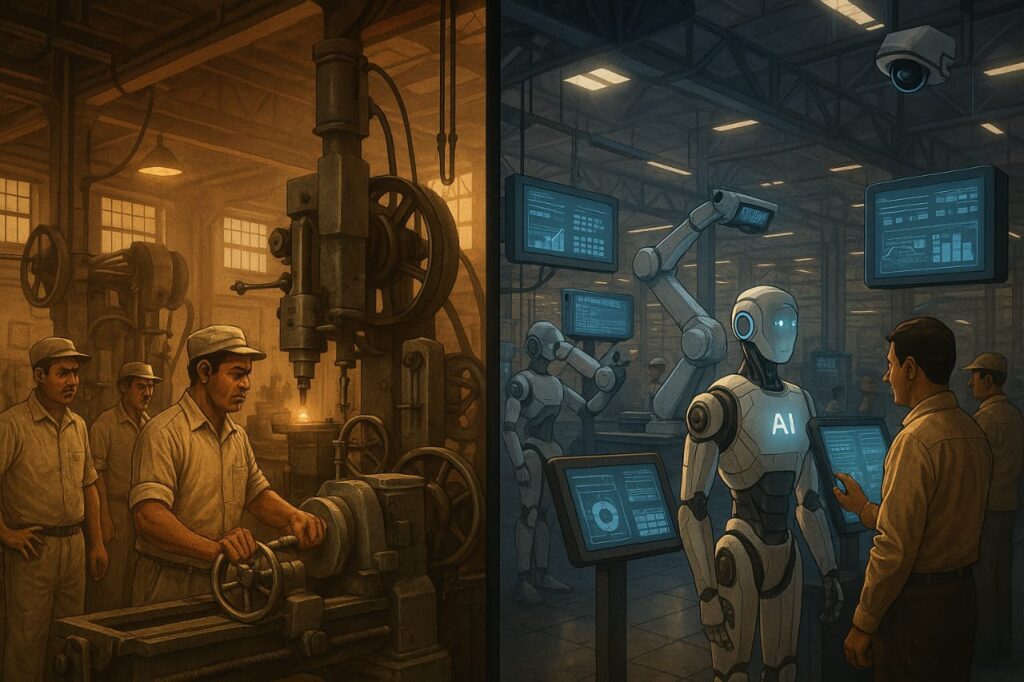

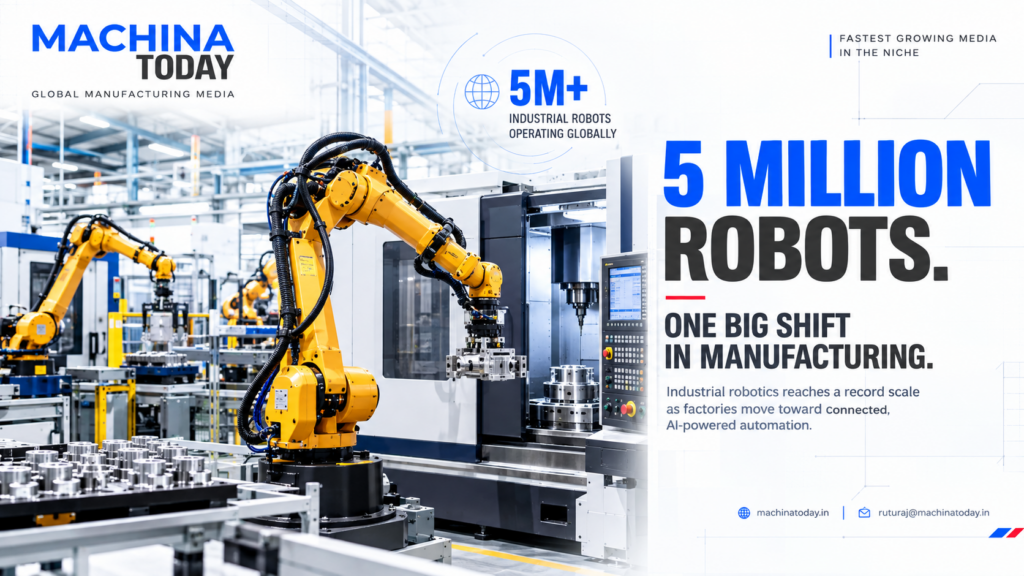
The global factory floor is becoming increasingly automated. According to the International Federation of Robotics (IFR), the number of industrial robots operating in factories worldwide reached approximately 5 million units in 2025 — a new record.
But the bigger story is not simply the number of robots.
It is where those robots are being deployed, why manufacturers are investing in them, and what this means for the next generation of CNC machining, automation and AI-driven manufacturing.
5 Million Robots: The Number Behind the Automation Boom
The IFR’s World Robotics 2026 data shows that the global operational stock of industrial robots increased by 9% in 2025, reaching approximately 5 million units.
At the same time, factories installed more than 600,000 new industrial robots during the year, representing an 11% increase in annual installations.
That means industrial robotics is no longer a niche automation technology used only by highly automated automotive factories.
Robots are increasingly becoming part of the wider manufacturing infrastructure.
From welding and assembly to machine tending, inspection, material handling and packaging, automation is moving into a much broader range of production environments.
Machina Today Insight: The important shift is from “robots as machines” to robots as production infrastructure.
China Continues to Drive Global Robot Adoption
China remains the world’s largest market for industrial robot installations.
In 2025, Chinese factories installed approximately 354,000 industrial robots, around 59% of global installations, according to IFR data. Annual installations increased by about 20%.
China’s scale is significant because its manufacturing ecosystem combines:
- Large-scale automotive production
- Electronics manufacturing
- Metalworking
- Battery production
- Semiconductor-related manufacturing
- Machinery production
- Increasing domestic robot manufacturing
The result is a manufacturing environment where automation can be deployed at enormous scale.
This also matters for machine-tool companies because robotic automation increasingly works alongside CNC machines rather than replacing them.
A modern production cell can combine:
CNC machine + robot + tooling + vision + sensors + software + data
That combination is becoming one of the defining architectures of smart manufacturing.
The United States Moves Into Second Place
The U.S. also recorded strong growth.
According to IFR, U.S. industrial robot installations reached approximately 38,500 units in 2025, an increase of about 12%, moving the country ahead of Japan in annual robot installations.
Automotive remains a major customer, but robotics demand is also expanding into areas such as food, warehousing, logistics and other manufacturing applications.
For American manufacturers, automation is increasingly connected to several structural pressures:
- Labor availability
- Productivity
- Reshoring
- Production flexibility
- Quality consistency
- Supply-chain resilience
This creates opportunities not only for robot manufacturers but also for CNC machine builders, system integrators, tooling companies and industrial software providers.
India Is Growing — And That Matters
One of the numbers that deserves more attention is India’s growth.
India installed almost 10,500 industrial robots in 2025, up approximately 15% year over year, according to IFR.
Even more significant is the longer-term trend.
Between 2020 and 2025, India’s annual industrial robot installations grew at an average rate of approximately 27% CAGR, according to IFR. India ranked sixth globally for annual installations in 2025.
For India’s manufacturing sector, robotics could become increasingly important in:
Automotive → Auto components → CNC machining → Electronics → Metal fabrication → Warehousing → General manufacturing
The opportunity is particularly interesting for CNC machine shops.
A robot does not necessarily need to perform an entire manufacturing operation.
It can simply automate the repetitive tasks surrounding a CNC machine.
For example:
Raw material → Robot loading → CNC machining → Robot unloading → Inspection → Finished component
This can transform a conventional CNC machine into part of a more automated production cell.
The Real Competition May Not Be Humanoid Robots
Humanoid robots are attracting enormous attention.
But today’s manufacturing reality is somewhat different.
The vast majority of industrial automation is still based on specialized machines designed for specific tasks.
That includes:
- 6-axis industrial robots
- Collaborative robots
- Autonomous mobile robots
- Robotic welding systems
- Machine-tending robots
- Vision-guided robots
- Automated storage systems
- Automated inspection systems
The IFR’s industrial robot numbers illustrate the enormous scale already achieved by conventional industrial automation.
Meanwhile, the humanoid market remains comparatively small.
IFR-related data reported in September 2026 estimated approximately 7,000 humanoid robots were sold globally in 2025 for industrial and professional applications.
That is tiny compared with the millions of conventional industrial robots already operating.
So what comes next?
It may not be a simple battle between “humanoid robots” and “traditional robots.”
Instead, manufacturing could develop toward a combination of:
Industrial robots + AI + machine vision + autonomous mobility + CNC + digital manufacturing software
This broader category is increasingly being described as physical AI.
Physical AI Could Change the Factory Floor
Arthur D. Little’s September 2026 analysis estimates today’s physical-AI market at around $18 billion, with humanoids representing only a portion of that market.
Its analysis projects the broader physical-AI market could reach approximately $60–100 billion by 2030.
The distinction is important.
Physical AI is not limited to a robot that looks like a human.
It refers more broadly to systems capable of perceiving their environment, making decisions and taking physical action.
In manufacturing, that could mean a robotic system that can:
- Identify a component using vision
- Determine its orientation
- Load the component into a CNC machine
- Monitor the machining process
- Detect anomalies
- Remove the finished component
- Inspect the result
- Decide what happens next
That is a much broader concept than simply giving a robot a human-shaped body.
What This Means for CNC Manufacturing
For the CNC industry, the robotics boom could be particularly important.
The next generation of automated machining environments is likely to focus on connected production cells rather than isolated machines.
Imagine a machining cell where:
CNC + Robot + Tool Management + Vision + Inspection + AI + MES
are connected.
The machine performs the cutting.
The robot handles material.
Vision systems identify and inspect components.
Sensors monitor production.
Software collects data.
AI can potentially identify patterns and assist with decision-making.
The result is a manufacturing system that can operate with significantly less manual intervention.
Automation Does Not Mean “No Humans”
One of the biggest misconceptions about industrial robotics is that automation simply removes people from manufacturing.
In reality, automation changes the type of work required.
As repetitive tasks become automated, manufacturers need people capable of:
- Programming robots
- Programming CNC machines
- Maintaining automation systems
- Integrating machines
- Managing production data
- Troubleshooting equipment
- Designing automated cells
- Optimizing manufacturing processes
The manufacturing workforce therefore needs to evolve alongside the technology.
The challenge is not simply “How many robots can a factory install?”
It is:
“How effectively can humans and machines work together?”
Where the Growth Could Happen Next
The IFR expects global industrial robot installations to continue increasing.
Its outlook projects approximately 655,000 installations in 2026, followed by approximately 806,000 installations by 2029.
Several factors are supporting this long-term demand.
1. Labor shortages
Manufacturers in many regions are searching for ways to maintain production despite workforce constraints.
2. Reshoring and localization
Companies are reconsidering supply chains and increasing manufacturing capacity closer to their customers.
3. Quality requirements
Automated processes can improve repeatability for suitable applications.
4. Productivity pressure
Manufacturers need to produce more while controlling costs.
5. AI and machine vision
Improved perception and software capabilities are expanding the range of tasks that automation can perform.
6. Easier integration
Modern robots and automation platforms are becoming easier to program and integrate into production environments. IFR identifies easier programming and system integration as factors supporting wider adoption.
The Manufacturing Story Behind the 5 Million Robots
The headline may be “5 million robots.”
But the deeper manufacturing story is about something larger.
Factories are gradually moving from individual machines toward connected automated production systems.
The robot is only one component.
The future factory could combine:
**CNC machines
- Robotics
- Machine vision
- Sensors
- AI
- Digital twins
- MES
- Automated inspection
- Predictive maintenance
- Industrial networking**
The companies that successfully connect these technologies could create manufacturing environments that are more flexible, data-driven and automated.
Machina Today Take
Five million industrial robots operating worldwide is more than a milestone — it is evidence that factory automation has entered a new scale.
The most interesting development may not be whether humanoid robots eventually become common.
It is how quickly specialized robotics, CNC automation, machine vision and AI become integrated into everyday manufacturing.
For machine-tool manufacturers, automation companies and CNC shops, the question is increasingly shifting from:
“Should we automate?”
to:
“Which part of our production should we automate first?”
The answer will be different for every factory.
But one thing is becoming increasingly clear:
The automated factory is no longer a future concept. Millions of robots are already working inside it.
Key Facts at a Glance
| Metric | 2025 |
|---|---|
| Industrial robots operating globally | ~5 million |
| Growth in operational robot stock | +9% |
| New industrial robot installations | 600,000+ |
| Growth in annual installations | +11% |
| China installations | ~354,000 |
| U.S. installations | ~38,500 |
| India installations | ~10,500 |
| India’s 2020–2025 installation CAGR | ~27% |
| Forecast global installations, 2026 | ~655,000 |
| Forecast global installations, 2029 | ~806,000 |
*Sources: International Federation of Robotics, World Robotics 2026; additional analysis from Arthur D. Little and current reporting. *
Frequently Asked Questions
How many industrial robots are currently operating in factories?
The International Federation of Robotics reported approximately 5 million industrial robots operating worldwide in 2025.
How many industrial robots were installed in 2025?
More than 600,000 new industrial robots were installed globally in 2025.
Which country installed the most industrial robots?
China remained the world’s largest market, installing approximately 354,000 industrial robots in 2025.
How many robots did India install?
India installed almost 10,500 industrial robots in 2025, according to IFR data.
Are humanoid robots replacing industrial robots?
Not at present. Humanoid deployments remain small compared with the established industrial robotics market. IFR-related data estimated around 7,000 humanoid robots sold for industrial and professional applications in 2025, although the category is developing rapidly.
What is physical AI?
Physical AI broadly refers to intelligent machines that can perceive the physical world, make decisions and perform actions within it. It includes industrial robotics and other autonomous systems, not only humanoid robots.
What Do You Think?
Will the next major manufacturing revolution come from humanoid robots — or from specialized robots becoming smarter, cheaper and more connected?
And for CNC manufacturers:
How much of a modern machine shop should be automated?
Share your view in the comments.
Sources & Further Reading
International Federation of Robotics — World Robotics 2026
IFR: Five Million Robots Now Operate in Factories Globally
Arthur D. Little — Physical AI Market Analysis
Arthur D. Little: Specialized Physical AI Captures Value
Related reporting: The original news story that prompted this analysis was published by Yahoo Finance/Euronews on September 29, 2026.
This Machina Today article is an original editorial analysis. It does not reproduce the source article’s text. Statistics are independently attributed to their underlying sources.
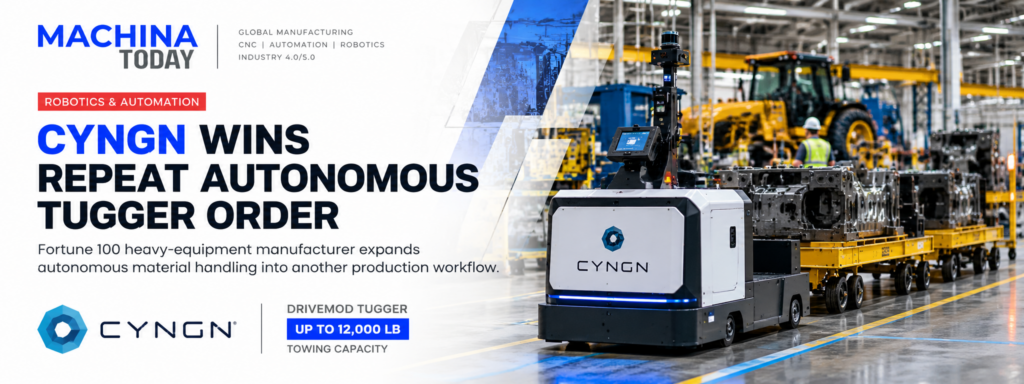
Cyngn Wins Repeat Autonomous Tugger Order from Fortune 100 Heavy Equipment Manufacturer
Autonomous material handling is moving from pilot projects toward repeatable production workflows as Cyngn expands…

Okuma America Corporation Appoints Summer Cline as New Chief Financial Officer
Summer Cline has been promoted to Chief Financial Officer (CFO) of Okuma America Corporation, strengthening…
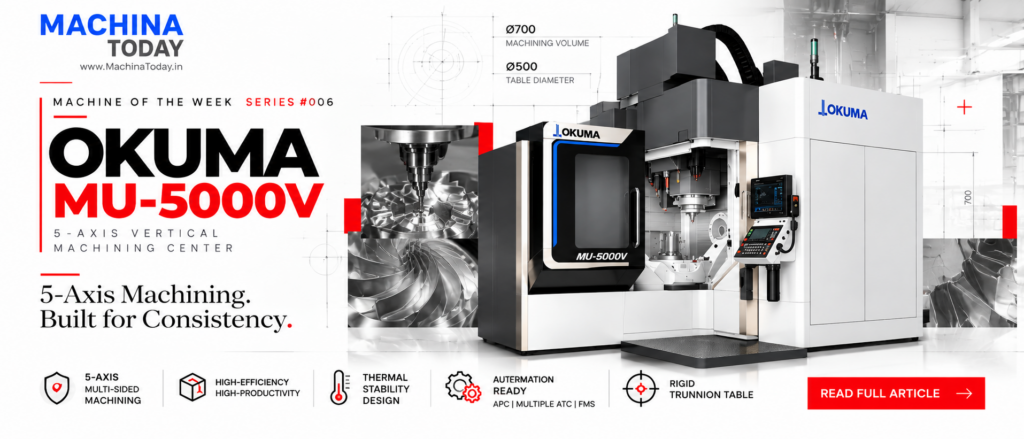
Okuma MU-5000V: 5-Axis CNC Machining Center for High-Precision Multi-Sided Machining
The Okuma MU-5000V is a 5-axis vertical machining center designed for high-efficiency, high-productivity multi-sided machining….
Five Million Industrial Robots Are Now Working in Factories — What It Means for Manufacturing
The global factory floor is becoming increasingly automated. According to the International Federation of Robotics…
3-Axis vs 5-Axis CNC Machining: What’s the Difference?
3-axis vs 5-axis CNC machining is not simply a comparison between a basic machine and…
CNC Machining: Complete Guide to CNC Machines, Processes, Types and Applications
CNC machining is one of the foundations of modern manufacturing. From aerospace structures and automotive…