
FANUC America is positioning IMTS 2026 as a showcase for the next stage of industrial automation—where robotics, CNC, artificial intelligence, digital twins and connected manufacturing increasingly operate as one production ecosystem.
The conversation around artificial intelligence in manufacturing is moving beyond software.
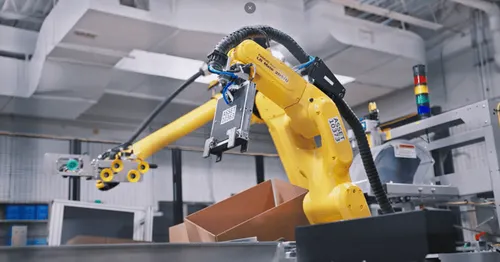
At IMTS 2026, FANUC America plans to demonstrate how Physical AI, industrial robots, collaborative robots, CNC systems, digital twins and machining automation can work together to address real production tasks.
The company will showcase its technologies at Booth 338900 during IMTS 2026, which runs September 14–19 at McCormick Place in Chicago. FANUC says its demonstrations are focused on improving productivity, flexibility and the speed at which automation can be deployed.
But the bigger story is not simply the number of robots or machines on display.
It is the direction of manufacturing technology.
From Programmed Automation to Physical AI
Traditional industrial automation has largely depended on predefined programs and controlled production environments.
FANUC’s IMTS 2026 demonstrations point toward a different model: machines that can increasingly perceive, interpret and respond to physical environments.
FANUC says it is working with technology companies including Google Cloud, NVIDIA and Amazon Web Services (AWS) on Physical AI technologies.
One demonstration developed with Google Cloud will show AI agents interpreting handwritten instructions and directing robots to identify, locate and kit parts required for manufacturing operations.
Another demonstration, called CRX Vibe Coding, will explore how generative AI and natural-language commands can be used to generate Python code and robot programs.
That matters because programming remains one of the barriers to deploying automation across a wider range of manufacturing operations.
The potential shift is significant:
Instead of programming every movement manually → operators increasingly communicate what needs to happen → AI-assisted systems help translate that intent into machine actions.
FANUC is presenting this as part of a broader move toward more intelligent and adaptable automation.
AI Meets Vision, Force and Robotics
One of the most important aspects of FANUC’s Physical AI demonstrations is that the technology is not being presented as AI software alone.
The demonstrations combine AI with physical sensing and robotic movement.
A dual-arm CRX-5iA application will demonstrate connector assembly using vision and force data to help the robot perform complex insertion and assembly operations.
Another demonstration will show intelligent bolt tightening on moving parts using Inbolt Physical AI tracking, NVIDIA-powered processing, a CRX-20iA/L robot and an R-30iB Mini Plus Controller.
This represents an important direction for industrial robotics.
The objective is not simply to make robots move faster.
It is to make robots more capable of responding to changing physical conditions.
For manufacturers, that could become increasingly important in applications where part position, orientation or production conditions are not perfectly fixed.
FANUC Is Bringing AI Into CNC Machining
The Physical AI story at FANUC’s IMTS booth also extends into CNC machining.
FANUC says its demonstrations will include:
- AI-powered optimal toolpath generation
- Intelligent program generation based on user instructions
- Digital-twin-based machining improvements
- Autonomous failure recovery
These technologies connect the traditionally separate worlds of CNC programming, process optimization and artificial intelligence.
The potential implication is straightforward: CNC systems could become increasingly capable of helping manufacturers optimize machining processes rather than simply executing predetermined instructions.
For machine shops dealing with complex parts, changing production requirements and pressure to reduce setup and programming time, this direction deserves attention.
Digital Twins Could Change How Automation Is Commissioned
Another major theme at FANUC’s IMTS 2026 showcase is digital twin technology.
FANUC will demonstrate how digital twins and virtual commissioning can be used to simulate robotic and machining applications before physical equipment is installed.
For CNC machining, the company’s digital twin suite includes:
- CNC Reflection Studio
- CNC Guide 2
- Surface Estimation
- Tool Path Optimizer
- Smart Digital Twin Manager
According to FANUC, these tools can be used to simulate, validate and optimize machining processes before production begins, helping identify problems earlier and reduce wasted time and material.
For robotic automation, FANUC says digital twins can help manufacturers design, validate and optimize applications before installation.
That creates an important change in the engineering workflow.
Physical machine first?
Design → Install → Program → Test → Fix → Production
Digital-first approach?
Design → Simulate → Validate → Optimize → Install → Production
The second approach has the potential to move more engineering work into the virtual environment before commissioning begins.
NVIDIA Isaac Sim Joins FANUC’s Digital Twin Demonstration
FANUC will also feature NVIDIA Isaac Sim in a live digital twin demonstration involving robotic spot welding and integration with FANUC’s ROBOGUIDE platform.
The companies say the integration is intended to give developers a way to build and test AI-driven manufacturing solutions in virtual environments before deployment to physical systems.
FANUC will additionally demonstrate synchronization between a virtual and physical CRX-5iA application involving computer hard-drive handling.
The broader message is clear:
Simulation is becoming part of the automation development process—not simply a visualization tool.
New FANUC Collaborative Robot Technology at IMTS 2026
FANUC is also expanding its CRX collaborative robot portfolio.
The company will introduce the CRX-3iA, a portable collaborative robot with a 3 kg payload and 11 kg weight, according to FANUC.
More importantly, IMTS 2026 will mark the debut of the R-50iA Compact DC Controller, designed for CRX robots mounted on autonomous mobile robots.
FANUC says the controller can operate directly from 24V to 48V DC battery power, eliminating the need for a separate inverter and simplifying integration into mobile robotic systems.
The connected manufacturing demonstration will show CRX robots performing applications including:
- Assembly
- Machine tending
- Part transport
- Inspection
- Washing
The R-50iA platform also includes Ethernet connectivity, Python support, advanced vision capabilities and cybersecurity certification, according to FANUC.
FANUC’s Next-Generation CNC Platform
The CNC side of the showcase is equally important.
FANUC will highlight its 500i-A CNC, described by the company as a next-generation control platform designed to improve manufacturing performance, simplify programming and enhance usability.
Demonstrations will include:
- Reduced cycle times
- Automatic programming from CAD models
- Advanced tool management
FANUC will also show new industrial PC models for touch-based programming directly at the CNC machine, along with its next-generation αi-D Series servo motors, retrofit applications and 5-axis machining technologies.
This demonstrates that FANUC’s IMTS strategy isn’t exclusively about robotics.
The company is connecting CNC + robotics + AI + simulation + connected manufacturing into one broader automation story.
Three New ROBODRILL DC Series Machines
IMTS 2026 will also mark the debut of FANUC’s next-generation ROBODRILL DC Series machining centers.
ROBODRILL D54CS
The D54CS is designed for heavy drilling as well as high-speed drilling and tapping in S50C steel.
FANUC says it combines a 10,000-rpm high-torque spindle with Smart Spindle Load Control.
ROBODRILL D74CS
The D74CS features a new 12,000-rpm high-acceleration spindle and software functions and G-codes designed specifically for ROBODRILL applications and cycle-time reduction.
ROBODRILL D116CS
The D116CS expands the machine’s working envelope with 1,100 mm of X-axis stroke and 600 mm of Y-axis stroke.
FANUC says the machine uses a high-inertia DDR-TiB and will demonstrate high-precision positioning and high-speed processing of large electric vehicle instrument panels.
Together, these machines show that FANUC’s automation strategy still has a strong foundation in the core manufacturing process: machining performance.
Robotics Beyond Machine Tending
FANUC’s IMTS showcase also covers applications across the factory.
In assembly, a CRX-30iA with an R-50iA Mate Controller will demonstrate planetary gear assembly using integrated force control.
Another application will demonstrate high-torque bolt tightening with real-time process feedback, torque validation and quality verification.
In welding, the CRX-3iA will demonstrate vertical-up welding on structural steel.
FANUC will also showcase two R-2000 E Series robots in automotive spot welding, while demonstrating digital twin capabilities involving NVIDIA Isaac Sim.
And in robotic machining, the M-810/190-20B will demonstrate robot-based milling, drilling and tool changing using FANUC CNC and robot G-Code technologies.
The applications underline an important point:
Industrial robots are no longer being positioned simply as machine-tending equipment.
They are increasingly being integrated into machining, joining, assembly, inspection, finishing and other production processes.
FANUC Is Also Taking Aim at Robotic Painting
FANUC’s showcase extends into finishing applications.
The new P-55/15-21A paint robot will demonstrate overhead conveyor line tracking while painting moving football helmets.
The application is designed to demonstrate how robotic finishing can maintain consistent paint application even when parts are moving.
The R-50iA controller will also be featured in the application.
Connected Manufacturing: The Layer Behind the Machines
Perhaps one of the most overlooked parts of the announcement is FANUC’s connected manufacturing portfolio.
At IMTS, the company will feature technologies including:
- Factory AI
- Zero Down Time powered by AWS
- AI Servo Monitor
- Customer portal technologies
- Connected manufacturing solutions
FANUC says these technologies are intended to help manufacturers monitor equipment performance, maximize uptime, support workforce training and gain actionable insights from manufacturing operations.
This creates a bigger picture.
The modern factory isn’t just about buying a robot or CNC machine.
It is increasingly about connecting machines, software, data, simulation, AI and people.
What FANUC’s IMTS 2026 Showcase Really Means
The most interesting part of FANUC’s IMTS announcement isn’t any individual robot, CNC or software platform.
It is the convergence of technologies.
For years, manufacturing automation could be viewed as separate technology categories:
CNC → Robotics → Vision → Software → Simulation → Data
FANUC’s IMTS 2026 demonstrations increasingly connect those categories:
AI + Vision + Force Sensing + Robotics + CNC + Digital Twins + Data
That convergence could have a major impact on how factories approach automation.
The future factory may not be defined by how many robots it has.
It may be defined by how intelligently those machines can work together.
Why This Matters for Manufacturers
For manufacturers considering automation investments, FANUC’s IMTS demonstrations highlight several areas worth watching.
1. Programming
Natural-language and AI-assisted programming could reduce some of the expertise required to deploy certain robotic applications.
2. Commissioning
Digital twins and virtual commissioning can allow manufacturers to test systems before physical installation.
3. Flexibility
Vision, force sensing and AI-based perception can help robots deal with more variable production environments.
4. CNC Productivity
AI-assisted toolpath generation, automated programming and next-generation CNC controls could influence machining workflows.
5. Mobile Automation
The combination of CRX robots with autonomous mobile robots points toward more flexible material movement and machine-to-machine automation.
6. Predictive and Connected Operations
Connected manufacturing systems can provide manufacturers with more visibility into equipment performance and uptime.
These are not isolated developments.
They are pieces of the larger transition toward software-defined, connected and increasingly intelligent manufacturing systems.
The Bigger IMTS 2026 Story
FANUC is not alone in bringing AI and advanced robotics into the manufacturing conversation.
Across the industry, Physical AI, digital twins, industrial robotics and AI-enabled automation are becoming major themes.
But FANUC’s IMTS 2026 showcase is notable because it brings these technologies together with the company’s established CNC, ROBODRILL and robotics platforms.
That makes IMTS 2026 an important event to watch for manufacturers evaluating what the next generation of factory automation could look like.
And the biggest question coming out of Chicago may not be:
“How fast can robots work?”
It may be:
“How intelligently can machines understand and respond to the factory around them?”
That is where the next phase of industrial automation could be decided.
FAQ: FANUC at IMTS 2026
What is FANUC showcasing at IMTS 2026?
FANUC will showcase robotics, Physical AI, CNC automation, collaborative robots, digital twins, virtual commissioning, ROBODRILL machining centers, connected manufacturing and robotic applications.
What is Physical AI in manufacturing?
Physical AI refers to AI-enabled systems that can interact with and respond to the physical world. FANUC’s IMTS demonstrations include robots using AI, vision, force data and other technologies to perform manufacturing tasks.
What FANUC machines are debuting at IMTS 2026?
FANUC says IMTS 2026 will mark the debut of its next-generation ROBODRILL DC Series, including the D54CS, D74CS and D116CS.
What is the FANUC R-50iA?
The R-50iA Compact DC Controller is designed for CRX collaborative robots mounted on autonomous mobile robots. FANUC says it supports 24V–48V DC battery power and is designed to simplify mobile robot integration.
Will FANUC demonstrate digital twins at IMTS 2026?
Yes. FANUC will demonstrate digital twins and virtual commissioning for both CNC machining and robotic applications, including a demonstration integrating NVIDIA Isaac Sim with FANUC ROBOGUIDE.
Where is FANUC at IMTS 2026?
FANUC America will exhibit at Booth 338900 at IMTS 2026 in Chicago.
Editorial Note
Machina Today is reporting on FANUC’s announced IMTS 2026 technologies based primarily on FANUC America’s September 3, 2026 announcement. Product capabilities and demonstrations described above are attributed to FANUC and should not be interpreted as independent performance testing by Machina Today.

IMTS 2026 Opens in Chicago: AI, CNC, Robotics and Automation Take Center Stage
IMTS 2026 is officially underway in Chicago, bringing the global manufacturing technology industry together at…
Top Aerospace Manufacturing Technologies in 2026: 10 Technologies Reshaping How Aircraft Are Built
Aerospace manufacturing is entering a new industrial era. From AI-driven engineering and digital twins to…
FANUC at IMTS 2026: Physical AI, Robotics and CNC Innovation Move Into the Factory
FANUC America is positioning IMTS 2026 as a showcase for the next stage of industrial…
How CNC Machines Improve Export Quality: From Precision Machining to Process Control
Global manufacturing is increasingly built around supply chains where components may be designed in one…

ANCA at IMTS 2026: New Leadership, Precision Tooling and the Next Manufacturing Shift
A new CEO. A legendary founder. One booth. And a manufacturing industry moving faster than…
WhizCut at AMB Stuttgart 2026: Smarter Cutting Tools Target Material Waste, Productivity and Sustainable Machining
WhizCut is set to present its precision-tooling portfolio at AMB Stuttgart 2026, with products focused…