

The Okuma MU-5000V is a 5-axis vertical machining center designed for high-efficiency, high-productivity multi-sided machining. Its rigid double-column construction, trunnion table, Thermo-Friendly Design and automation options make it a machine platform built around accuracy, process stability and production flexibility.
Okuma MU-5000V: Why This 5-Axis CNC Machine Matters
Modern manufacturers are increasingly looking beyond simply adding spindle speed or machine capacity. The bigger challenge is machining complex components accurately while reducing setups, maintaining consistency and preparing production cells for automation.
This is where 5-axis CNC machining becomes particularly important.
The Okuma MU-5000V combines simultaneous 5-axis machining capability with a rigid double-column structure and high-speed, high-accuracy trunnion table. Okuma says the machine is designed for high-efficiency and high-productivity multi-sided machining, while its Thermo-Friendly Design is intended to maintain machining consistency despite changes in ambient temperature and machine-generated heat.


What Is the Okuma MU-5000V?
The Okuma MU-5000V is a 5-axis vertical machining center developed for complex, multi-sided machining.
Its trunnion-table architecture allows the workpiece to be positioned for simultaneous 5-axis cutting, while the machine’s double-column construction provides a rigid structural platform.
According to Okuma, the machine can also be configured for APC, multiple ATC, automation and FMS, with expansion taking place at the rear of the machine.
This combination makes the MU-5000V relevant for manufacturers looking to move from conventional multi-setup machining toward more integrated 5-axis production.
Okuma MU-5000V Specifications
| Specification | Okuma MU-5000V |
|---|---|
| Machine type | 5-axis vertical machining center |
| Maximum machining volume | Ø700 × 500 mm |
| Table diameter | Ø500 mm |
| Spindle speed | 10,000 min⁻¹ |
| Spindle motor | 11/7.5 kW |
| Rapid traverse | 50 m/min |
| Tool magazine | 32 tools standard; 48, 64 and matrix options listed by Okuma |
| Y-axis travel | 1,050 mm |
| X-axis travel | 800 mm |
| Z-axis travel | 600 mm |
The highlighted specifications above are from Okuma’s current MU-5000V product information and published documentation. Configuration-dependent specifications should be confirmed with Okuma or an authorized distributor before purchasing.
1. Thermo-Friendly Design: The Stability Story
One of the most important engineering characteristics of the MU-5000V is thermal management.
Machining generates heat, while changes in shop-floor temperature can also influence machine geometry. For precision machining, thermal variation can therefore become a process-control issue.
Okuma’s Thermo-Friendly Design is intended to compensate for temperature effects around the machine and heat generated during machining. Okuma describes this approach as helping the MU-5000V maintain consistency from the first part to the last.
For manufacturers, the practical objective is straightforward:
more predictable machining → more consistent parts → fewer process interruptions.
The exact achievable accuracy, however, depends on the machine configuration, tooling, workholding, material, cutting parameters, environment and process setup.
2. Rigid Double-Column Construction
The MU-5000V uses a double-column structure designed to provide rigidity and accuracy.
Okuma pairs this structure with a trunnion table that keeps the workpiece movement at a low center of gravity. The manufacturer states that this architecture supports both heavy-duty cutting and high-speed finishing.
This is particularly relevant when machining complex components where rigidity, tool engagement and multi-axis positioning interact.
The machine is therefore not simply about adding two rotational axes.
It is about creating a structural platform capable of supporting those movements during demanding machining operations.
3. Ø500 mm Trunnion Table
The MU-5000V features a Ø500 mm table and a maximum machining volume of Ø700 × 500 mm according to Okuma’s highlighted specifications.
The trunnion architecture allows the workpiece to rotate and tilt while machining.
That can help manufacturers approach multiple faces of a component without repeatedly removing and repositioning the workpiece.
Why does that matter?
Traditional multi-sided machining may require several setups.
A 5-axis approach can potentially consolidate operations, depending on the component and process.
That can mean:
- Fewer workholding setups
- Reduced repositioning
- Better access to complex surfaces
- Improved process integration
- Greater flexibility for complex geometries
These benefits are process-dependent rather than automatic; part geometry and programming strategy remain critical.
4. 10,000 min⁻¹ Spindle
The MU-5000V specification highlighted by Okuma includes a 10,000 min⁻¹ spindle speed with an 11/7.5 kW spindle motor.
The spindle configuration provides a balance between cutting capability and high-speed machining applications.
For manufacturers, spindle selection should always be evaluated against:
material + tool diameter + cutting strategy + required surface finish + production volume.
A high spindle speed alone does not determine machining performance.
5. Automation-Ready Architecture
Automation is one of the strongest aspects of the MU-5000V platform.
Okuma states that the MU-5000V can be adapted for:
- APC — Automatic Pallet Changer
- Multiple ATC configurations
- Automation
- FMS — Flexible Manufacturing Systems
A notable design feature is that Okuma positions these expansion capabilities at the back of the machine, allowing automation integration without compromising the operator’s access and machine operation.
This makes the MU-5000V relevant not only as an individual machining center, but also as part of a broader automated manufacturing cell.
6. OSP Suite CNC Control
The MU-5000V is associated with Okuma’s OSP Suite control environment.
Okuma describes OSP Suite as an open system combining its intelligent technologies with software applications and a customizable operator interface. The system includes access to productivity applications and documentation and is designed around different operator requirements.
Okuma also connects its control environment with technologies including:
- Thermo-Friendly technologies
- Collision Avoidance
- Machining Navi
- 5-Axis Auto Tuning
- ECO-related functions
The exact functions available depend on the machine configuration and options.
7. 5-Axis Auto Tuning
Maintaining geometric accuracy in a 5-axis machine involves more than conventional 3-axis calibration.
Okuma’s 5-Axis Auto Tuning technology is designed to measure machine characteristics and apply compensation for geometric errors. Okuma describes a guided measurement process using a target sphere and multiple probing positions throughout machine travel and rotary movement.
For production environments, this type of technology is aimed at simplifying the process of maintaining 5-axis accuracy.
Where Can the Okuma MU-5000V Be Used?
The MU-5000V is designed around multi-sided and complex 5-axis machining.
Okuma has specifically described the MU-V Series as suitable for applications including aerospace and die/mold machining.
Potential application areas include:
Aerospace
Complex components often require multiple surfaces, curved geometries and controlled machining strategies.
Die & Mold
5-axis positioning can provide improved tool access to complex surfaces and reduce the need for multiple setups.
General Precision Manufacturing
Manufacturers producing complex industrial components can use 5-axis machining to consolidate operations where the part geometry allows it.
Energy and Heavy Engineering
The rigid machine architecture and multi-sided machining capability can be relevant to larger, complex components, subject to machine configuration and process requirements.
5-Axis Machining vs. Conventional Multi-Setup Machining
One of the biggest reasons manufacturers move toward 5-axis machining is process consolidation.
Consider a complex component requiring machining on several sides.
With a conventional approach:
Setup 1 → machining → reposition → Setup 2 → machining → reposition → Setup 3
A 5-axis process can potentially approach the same component with fewer setups.
The potential advantages include:
Reduced setup time
Less time can be spent repositioning the component.
Improved positional consistency
Keeping the component in the same workholding setup can reduce errors associated with repeated repositioning.
Complex geometry access
The rotary axes provide additional tool-access possibilities.
Production flexibility
Automation and pallet systems can further extend the production workflow.
However, 5-axis machining does not automatically make every component cheaper or faster. Programming, tooling, workholding, machine configuration and operator expertise remain important.
What Makes the MU-5000V Different?
The interesting part of the MU-5000V is not one individual specification.
It is the combination of technologies.
5-axis capability
For complex multi-sided machining.
Trunnion architecture
For controlled positioning and simultaneous 5-axis cutting.
Double-column structure
For rigidity and accuracy.
Thermo-Friendly Design
For thermal stability and process consistency.
OSP Suite
For CNC control and integrated intelligent technologies.
Automation compatibility
For APC, multiple ATC, automation and FMS configurations.
Together, these features position the MU-5000V as a production-oriented 5-axis platform rather than simply a machine with two additional rotary axes.
Advantages of the Okuma MU-5000V
Based on Okuma’s published specifications and product information, key advantages include:
1. Multi-sided machining capability
Designed specifically around 5-axis machining.
2. Rigid machine architecture
Double-column construction and trunnion design support the machine’s accuracy and cutting capability.
3. Thermal management
Thermo-Friendly Design addresses temperature-related machining variation.
4. Automation flexibility
APC, multiple ATC, automation and FMS configurations are supported.
5. Integrated control ecosystem
OSP Suite provides access to Okuma’s control and intelligent technologies.
6. Large machining envelope for its class
The published maximum machining volume is Ø700 × 500 mm.
Considerations Before Buying
A machine’s specification sheet should never be the only basis for a CNC investment.
Before selecting an MU-5000V configuration, manufacturers should evaluate:
- Part dimensions and weight
- Material being machined
- Required tolerances
- Surface-finish requirements
- Spindle requirements
- Tooling strategy
- Workholding
- Production volume
- Automation requirements
- ATC capacity
- Chip-management requirements
- Floor space
- Operator skill
- CAM and post-processor compatibility
- Service and application support
- Total cost of ownership
Most importantly, the final configuration should be matched to the actual production process.
Frequently Asked Questions
What is the Okuma MU-5000V?
The Okuma MU-5000V is a 5-axis vertical machining center designed for high-efficiency and high-productivity multi-sided machining, featuring a rigid double-column structure, trunnion table and Thermo-Friendly Design.
What is the table size of the MU-5000V?
The published table diameter is Ø500 mm.
What is the maximum machining volume?
Okuma lists the maximum machining volume as Ø700 × 500 mm.
What is the spindle speed of the Okuma MU-5000V?
The highlighted specification lists a 10,000 min⁻¹ spindle speed with an 11/7.5 kW spindle motor. Other configurations may differ.
Is the MU-5000V suitable for 5-axis machining?
Yes. The MU-5000V is specifically designed as a 5-axis vertical machining center, with a high-speed, high-accuracy trunnion table for simultaneous 5-axis cutting.
Can the MU-5000V be automated?
Yes. Okuma states that the machine can be adapted for APC, multiple ATC, automation and FMS.
What CNC control does the MU-5000V use?
The MU-5000V is associated with Okuma’s OSP Suite, an open control environment that supports configurable operator interfaces and access to intelligent manufacturing technologies. Exact control configuration should be confirmed for the specific machine.
Machina Today’s Editorial Take
The Okuma MU-5000V represents an important idea in modern CNC manufacturing: 5-axis machining is increasingly about process integration, not simply axis count.
Its combination of a trunnion table, rigid double-column construction, thermal-management approach and automation options creates a platform aimed at manufacturers machining complex components where accuracy, repeatability and production flexibility matter.
For manufacturers considering the transition toward more integrated 5-axis production, the key question is not simply:
“Do we need a 5-axis machine?”
It is:
“Which operations can we consolidate if we move to 5-axis machining?”
That is where the potential business value of a platform like the MU-5000V becomes particularly interesting.
Official Source
For the latest specifications, available configurations and manufacturer information, see the official Okuma MU-5000V product page.
Cyngn Wins Repeat Autonomous Tugger Order from Fortune 100 Heavy Equipment Manufacturer
Autonomous material handling is moving from pilot projects toward repeatable production workflows as Cyngn expands…
Okuma America Corporation Appoints Summer Cline as New Chief Financial Officer
Summer Cline has been promoted to Chief Financial Officer (CFO) of Okuma America Corporation, strengthening…
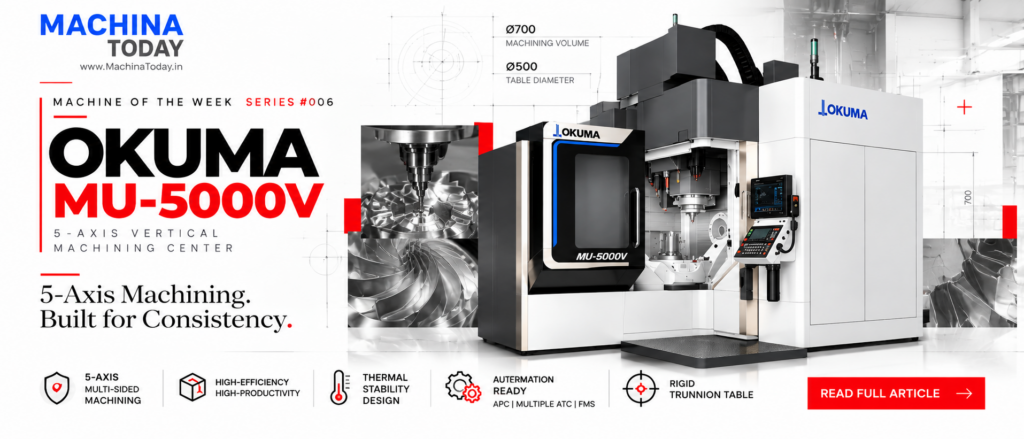
Okuma MU-5000V: 5-Axis CNC Machining Center for High-Precision Multi-Sided Machining
The Okuma MU-5000V is a 5-axis vertical machining center designed for high-efficiency, high-productivity multi-sided machining….
Five Million Industrial Robots Are Now Working in Factories — What It Means for Manufacturing
The global factory floor is becoming increasingly automated. According to the International Federation of Robotics…
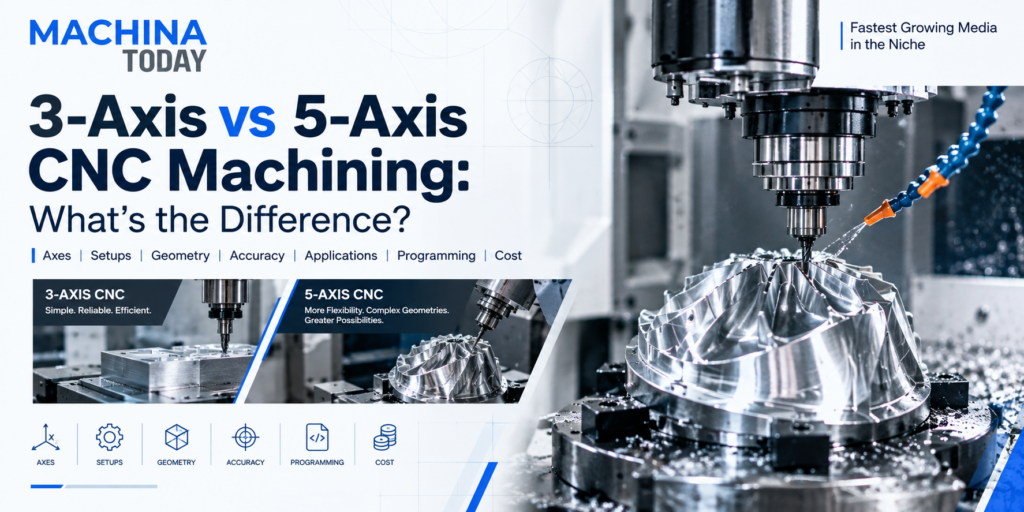
3-Axis vs 5-Axis CNC Machining: What’s the Difference?
3-axis vs 5-axis CNC machining is not simply a comparison between a basic machine and…
CNC Machining: Complete Guide to CNC Machines, Processes, Types and Applications
CNC machining is one of the foundations of modern manufacturing. From aerospace structures and automotive…

